Thursday, February 3, 2011

Won't Miss #284 - spouse denigrating


The Japanese are generally a modest lot, sometimes, far too modest. When speaking of their spouses, they feel almost obliged to never "boast" about his or her positive attributes and to talk up negative qualities. You're far more likely to hear a woman talk about her lazy, selfish, childish husband and a man talk about his fat, incompetent, messy wife than hear even the slightest complimentary word. In fact, it's seen as poor manners to say things like your wife is a fabulous piano player or that your husband is a crackerjack repairer of computer systems.

I realize that this is a cultural difference, but it makes me uncomfortable both to hear such unkind things (even when they are almost certainly not sincere) and to consider the fact that it means people aren't giving their spouse their due out of societal obligation, and I won't miss it.

Wednesday, February 2, 2011

Will Miss #283 - no big deal birthdays


In Japan, people don't make a big deal about birthdays, particularly when it comes to adults. Often, celebration extends only so far as taking a friend out to dinner and/or serving up a "surprise" cake. It's very rare for people to give each other actual gifts except perhaps something very modest like a bit of chocolate or a small cake from a designer shop. In America, adults often feel burdened by birthdays as they are obliged once a year to conjure up an appropriate gift for someone who doesn't need anything or who they don't know particularly well.

While I'm happy to convey birthday wishes and give gifts when I really want to, I'm happier living in a culture without the expectation that presents will be proffered on adult birthdays, and I'll miss that.

Tuesday, February 1, 2011

Won't Miss #283 - dry muffins and cakes


If you don't bake, you may not know what components make baked goods moist. Most people assume that it is the fat that makes things like a muffin moist. Well, it is, but it's only half of the equation. The other half is sugar and that is why most muffins and many (but not all!) cakes in Japan have poor texture. The Japanese are notorious for whining that everything in America is "too sweet" for their palates. To compensate for the desire for less sweet baked goods, bakers in Japan use less sugar and the result is fatty, but dry muffins and cakes. You can't just ditch sugar in a recipe and expect a less sweet, but good result. There are ways to compensate for this (like using unsweetened fruit puree such as applesauce, prunes, etc.) to enhance moisture without using more sugar, but the bakers here don't seem to know or care to adjust the recipes. Sometimes, I wake up thinking I'd love to go off to a bakery and buy a nice muffin as a rare treat for breakfast, then I remember that every purchase is a roll of the dice and the cards for a good result are stacked against me.

I won't miss the dry, unpleasant cakes and muffins in Japan.

Monday, January 31, 2011

Will Miss #282 - arm stockings


I have been asked on occasion to speculate about the motivations behind certain cultural differences between Japan and other countries. One of the questions I've been asked is why the Japanese value white skin so much. The usual answer I get from Japanese people is that they think it is more beautiful than darker skin tones. They say no more than that. I've heard many foreign people speculate that brown or tanned skin is associated with working the fields and paleness is the product of a life of privilege and leisure. I can't say if this is true or not, but I can say that the battle to avoid a "farmer's tan" is being waged with the aid of "arm stockings". Apparently, parasols alone aren't protection enough for the extremities.

I'll miss seeing women who are so focused on keeping their arms white that they'll wear long socks on their arms in the stifling hot summer.

Friday, January 28, 2011

Won't Miss #282 - "the stare and swerve"


Somewhere in the cobwebbed areas of my deeper memory, I recall seeing a comedic scene in a movie or T.V. show where a person is riding a bike and is so distracted by an attractive women, that he doesn't look where he is going and crashes into something. Seems rather silly, eh? Well, there is a situation in Japan that happens to me which makes it seem much more plausible. When I'm riding my bike, other bike riders coming in the opposite direction (when not busy talking or texting and staring at their cell phones) suddenly become stunned into a stupor at the sight of a foreigner. They gawk, and their bike starts to glide toward me. This is when I either have to defensively drive or ring my bell and adopt an angry look to get them to put their eyes back on the damn street. Two people in the last 3 months have actually crashed while gawking at me (I kid you not - one was an old man and the other a little girl).

I won't miss being nearly run into by idiots who seem stunned into paralysis at the sight of a "gaijin." (foreigner)

Thursday, January 27, 2011

Will Miss #281 - cooking terms without pretense


I like to cook, and I follow several cooking blogs and a few forums. There is something that drives me crazy and that is people who use Japanese words instead of perfectly reasonable English equivalents because they're trying to sound like they know something other people don't. They're the types who like to toss around words like "umami" when they could say "savory" or "meaty" or who say even dumber things like "panko breadcrumbs" (which, incidentally, means "breadcrumbs breadcrumbs") instead of "Japanese breadcrumbs".* I don't have a pet peeve about Japanese words that are used when there is a lack of an adequate English equivalent, e.g. "sushi","miso". I only get irked when I sense that people are are going out of their way show off their knowledge about food by tossing in Japanese terms unnecessarily.

I'll miss hearing Japanese cooking terms because that's the language being spoken rather than because someone is trying to show off their culinary sophistication.

*When participating in such (English language) forums or commenting on web sites, I never use Japanese words when serviceable English is possible.

Wednesday, January 26, 2011

Won't Miss #281 - hanging

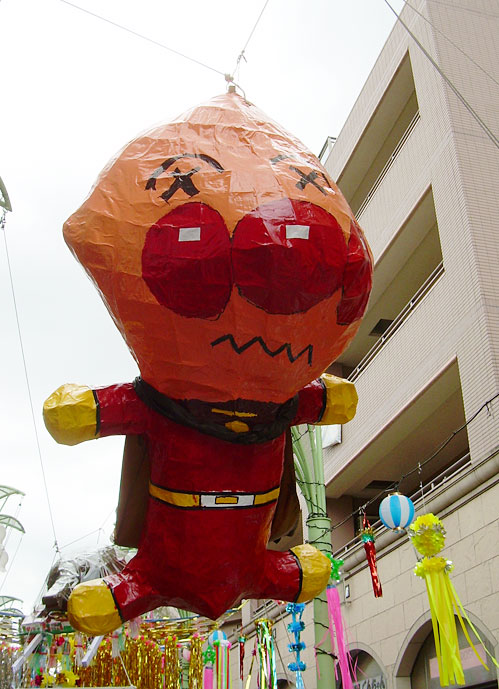
Poor Anpanman. He's had better days. 

The Japanese overwhelmingly support capital punishment. Latest statistics put it at 85.6% support, and my personal experiences speaking to Japanese people about this issue completely fall in line with these numbers. You can compare this to the United States, one of the other few developed countries that allows for the death penalty (albeit on a state-by-state basis - some states allow it and others do not) which has an average support rating of 65%. Personally, I don't condone the death penalty, but that's not what this is about. The thing that gives me the heebie jeebies in Japan is that the method of execution is hanging. It seems like a particularly inhumane and archaic way to kill someone, especially when arguably more humane options (like lethal injection) are available. Also, often the executions are simply carried out without announcing that they are going to occur. This seems somewhat odd, cowardly and unfair to the family or the condemned, particularly in the face of such overwhelming public support.

I won't miss reading about execution by hanging in Japan.

Tuesday, January 25, 2011

Will Miss #280 - typhoons in Tokyo

A tree top bends in the wind and the sky has darkened as a typhoon approaches.

I'm a big fan of dramatic weather. I love the sound of thunder and hard rain, and the charged feeling in the air before they come. There's something invigorating to me about nature proving who is boss as it bends tree tops, knocks over rows of bikes, and spits all over the windows. To that end, I like the atmosphere and reactions that surround typhoons in Tokyo. They are never that serious and people rarely get hurt in the city, but there seems to be a very urgent response from people nonetheless. At my former office, Japanese employees, particularly women, were sent home early on days when a typhoon was approaching (foreigners had to stay) as if they might be blown away in the wind if they didn't reach the safety of home first. People would tell you to be careful as if you might lose life and limb even though the worst that could generally happen was that you'd get really, really wet. One of my earliest experiences at my job was going to a "goodbye lunch" for a coworker in the middle of a raging typhoon that passed by a hinged metal sculpture that whipped around scarily in the wind.

I'll miss typhoons in Tokyo, and all of the human replies to their approach.

Monday, January 24, 2011

Won't Miss #280 - cultural enforcers


One of my earliest experiences in Japan occurred when I came here for a vacation in 1988. My then boyfriend, now husband, and I were riding on a train and standing next to each other. Because it was crowded, I leaned into him and against him with my hand resting on his chest. Of course, we were relatively affectionate, but not doing anything grostesque or over the top. A man came over and started stabbing his finger at us and aggressively saying, "this is Japanese!"  He was trying to tell us in bad English that we shouldn't have any contact with each other on the train. Other foreigners have been told by Japanese strangers that they "can't" do things in Japan which Japanese people themselves do. One foreign woman was going to eat an ice cream bar on the train, and a man told her it wasn't allowed in Japan. Japanese people eat on the trains (particularly young ones), but it is not considered good manners to do so. The people who tell the foreigners that some action is "not allowed" are too cowardly do the same to Japanese people carrying out the same actions because they know that they would be challenged for asserting something was a "rule" which everyone knows is a mere preference.

These cultural enforcers bully foreigners and make them believe that their opinion and cultural (or their own) preferences are actually rules or regulations and I won't miss them.

Friday, January 21, 2011

Will Miss #279 - taiko


Taiko is Japanese drumming. You sometimes see people playing at festivals and it's always an invigorating experience. People play in a high energy fashion and show great strength and stamina. You can't help but be affected by both the sound and the motion that is involved in the playing.

I'll miss seeing live performances with taiko.

Thursday, January 20, 2011

Won't Miss #279 - personal space differences

I didn't have a picture of someone invading a private part or orifice, but that kokeshi doll on the right looks annoyed at the proximity of the kokeshi doll on the left to her posterior, doesn't she?

The Japanese have very different ideas about personal space. They don't like to hug and feel very uncomfortable about it, but they have some habits which are far more invasive and offensive than hugs. One is kancho, in which people try to shove their hands as far as possible up another person's behind. I've also seen and heard about women's breasts being grabbed by other women. There was a commercial for weight loss a few years back where a woman who lost a lot of weight was greeted at the door by a friend and the friend remarked on her weight loss then poked her breasts several times as if she was checking a balloon's inflation level. I also had a British friend whose (adult) students goosed her breasts. You can also find blog posts about incidents of crotch-grabbing and rubbing among foreigners who have been essentially assaulted by both Japanese adults and children.

I won't miss a culture that thinks it is okay to touch or assault the most private places of other people's bodies as pranks or humiliation, but finds hugging, kissing, or other displays of physical affection unacceptable and embarrassing.

Wednesday, January 19, 2011

Will Miss #278 - bowing

This covers three strong aspects of Japanese culture - bowing, cleaning up after others and saying "welcome". 

Do you know what's great about the way Japanese greet one another? You don't have to touch anybody. If that sounds squeamish to a paranoid extent, go back and read my post here. I've seen enough public peeing, nasal excavation, and women walking out of toilets without washing their hands to make me think twice about shaking hands in greeting. If you see enough unhygienic and disgusting behavior, you really don't want to be touching people the first time you meet them.

I'll miss bowing, because I don't know where people have been or how clean their hands are and experience has taught me to err on the side of caution.