Wednesday, November 16, 2011

Will Miss #387 - tuning out incidental conversations


If you've ever sat in a coffee shop next to someone really noisy and had trouble tuning out the details of their personal life, you can understand where I'm coming from with this. I'll be the first to admit that my Japanese skill pretty much blows and that I have to pay attention to what is being said to understand. It's not the sort of thing which effortlessly enters my consciousness, but rather has to pass through a filter. This obviously has drawbacks, but also certain benefits. Except for the omnipresent "ne" that seems to punctuate the end of every sentence when people are conversing, I can tune out the chatter quite effectively.

It's easier to see the contents of other people's conversations as white noise when you're dealing with a second language and I will miss that.

Tuesday, November 15, 2011

Won't Miss #387 - whining about American portions


One of my students has a brother who lives in San Diego. He has gained 15 kg. (33 lbs.) in two years due to eating American-size meals. I suggested that he not eat everything he is served and prepare his own food more frequenlty, but she wasn't having any of that sort of crazy logic. No, it was the American food that was the problem, not his laziness about cooking or inability not to gobble down every morsel placed in front of him. I frequently hear students whine about how over-sized food servings are in restaurants in the U.S. No doubt, the portions are too big and this is linked to a cultural perception in the U.S. that value is linked to quantity. However, in my experience, they're too big in Japan as well at restaurants (at least in terms of carbs) and I manage this by simply not eating it all.

I won't miss hearing Japanese people complain that portions are too big in the U.S. when they eat it all up of their own volition (and they usually do, as if it were some challenge they had to meet). 

Monday, November 14, 2011

Will Miss #386 - learning (deeply) about Japanese business

OK, no matter how much I understand about Japanese business, I don't know why this video shop is named "Slum."

If you have ever gone into a video rental shop in Japan, you may note that there are often more foreign titles than domestic ones. What fairly obvious conclusion would you reach? If you're like most people (including myself), you would conclude that foreign titles are more popular than Japanese ones. Sometimes, especially for runaway hits like "24" and "Prison Break", that is very much true. However, that is not the reason why there are so many more of such titles in rental shops. The reason is that most of the foreign entertainment production companies use a system called PPT (payment per transaction) and domestic ones do not. That means that the foreign companies provide the discs for free and share the profits according to how often those titles are rented. The domestic ones usually sell their discs outright. Since the former is lower risk, rental shops prefer to stock foreign-made titles.

I have learned a great deal about Japanese business at a level of depth that few others have because of the type of work I do and the way in which I deal with people, and I will miss the way in which it has allowed me to reach well-informed conclusions about Japan and Japanese culture rather than the all-too-easy superficial conclusions that people (both foreign and Japanese) make.

Friday, November 11, 2011

Won't Miss #386 - lack of strong flavors


One of my coworkers was a chef in Australia and he remarked that he should appreciate the fact that Japanese food is quite subtle in taste, but the truth is that he actually finds Japanese food rather bland. I'll admit that my foreign taste buds also favor intense flavors. It's not that I can't appreciate some of the subtler flavors, but my favorite things are definitely stronger (yuzu koshoo, Tyrant Habanero snacks and wasabi, for instance). I'm exactly the demographic that things like "flavor-blasted" salted snacks back home are geared toward. While my Japanese friends and acquaintances praise things like konnyaku, plain rice, and tofu, I find them extremely boring. I can eat those things, but I'd rather have them mixed with something more flavorful. 

I won't miss the relative lack of strong flavors in Japan. 

Thursday, November 10, 2011

Will Miss #385 - (relative) economic parity


I've said before that Japan conducts a sort of "soft socialism", but it's not necessarily rooted in the redistribution of wealth. There is, however, relative economic parity in Japan with a large middle class, few rich people, and few poor people. This is accomplished by not offering presidents and CEOs obscenely lavish salaries and keeping the bottom income bracket a little further from the rocks and by not undercutting employees in order to service stock holders. The Japanese do not embrace conspicuous wealth and overtly disapprove of the flaunting of wealth. Though they aren't known for their political activism or complaining, it is clear to me from years of talking to Japanese folks that they will not easily suffer their company leaders being grotesquely overpaid while the people at the bottom lose lifetime employment and financial security. Being roughly financially in a similar situation as others in Japan means people feel like they are in the same boat lifestyle-wise. It undercuts feelings of envy, keeps crime low, and makes people more satisfied with their quality of life. 

I will miss the social benefits of living in a society in which most people live at approximately the same economic level. 

Wednesday, November 9, 2011

Won't Miss #385 - bait and switch fruit stands


Fruit in Japan is expensive, though not quite as obscenely so as most foreign folks believe. Still, many Japanese people do not routinely eat fruit except for bananas because it's on the dear side and that makes it hard to include as part of their regular diet. Fruit is often a treasured gift, unless it is persimmons that are harvested by the truckload and freely dispensed when in season. Because of the high price of fruit, one can get pretty excited at the prospect of scoring some for a low price as seems possible in the fruit cart pictured above. Large white peaches are usually 100 yen ($1.25) apiece or more. This cart seems to be offering them at the bargain price of 5 peaches for a mere 300 yen. The thing is that this is a bait and switch situation. When you walk up to the cart and try to buy them, they'll tell you that some anemic runts of the litter that are hidden out of easy view are what you can get for the low price (worms and bruises thrown in for free). The prize beauties on top are about 150-200 yen each. 

It's possible that some of these carts are selling what they seem to sell, but in my experience, they are always trying to pull a fast one and I won't miss this sort of shady dealing. 

Tuesday, November 8, 2011

Will Miss #384 - watching the engineers


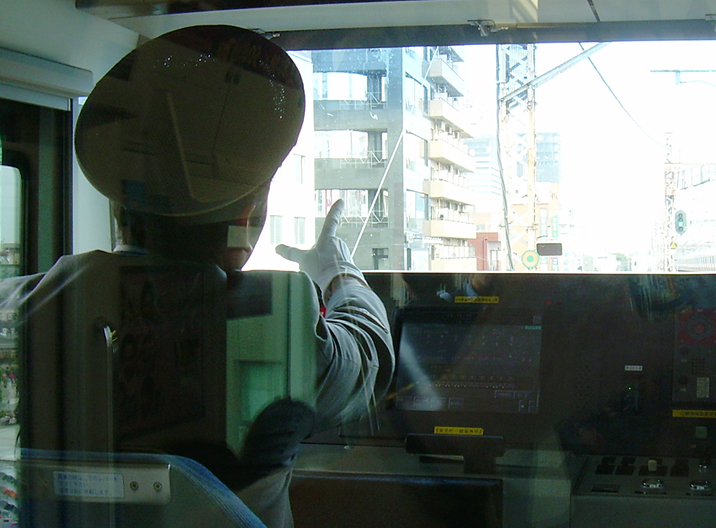
I don't know what it's like to run a train in America, especially in a metropolis like New York in which there is a large and complex system servicing a wide area. I can say that standing behind the engineer and watching how he operates when you get on a Japan Railway train is a pretty fascinating experience. He is sitting in there alone, but follows a very rigid routine of gesturing and movement. At first, I didn't realize why he pointed so often with his pristinely clean white-gloved hand then I realized he does so in recognition of signal lights. Even though they could easily not go through this routine out of view of other employees, they all do this because it's what they are supposed to do (and I'm guessing this sort of interaction keeps them alert).

To me, the way in which this work is meticulously followed by people in formal uniforms is a reflection of some of the best Japanese culture has to offer in terms of following a carefully carried out work ethic and I will miss it. 

Monday, November 7, 2011

Won't Miss #384 - Japanese (whatever) is "better"

Even the frozen French fries are better in Japan because, you know, they mix them with mini-weenies. 

Upon returning from a trip to Hawaii, one of my students asked me if I thought Japanese watermelon was sweeter than American watermelon. My truthful reply was that I've had sweet melon in both countries and relatively tasteless stuff in both of them. I've probably had more so-so watermelon in Japan simply because I've been an adult here longer and bought more of it. My student looked shocked at this reply and said that she really thought Japanese watermelon was "better". I will grant one thing; Japanese watermelon has a different taste and smell. It's not "better", but is absolutely "different". It's like American and Japanese pumpkin. Both are good, but have unique properties and need to be prepared differently to suit their strengths, but Japanese people are always telling me that all things Japanese are superior to all things American.

The bottom line is that we tend to like things the way we're used to them. It's entirely subjective, and it's tiresome hearing people say that everything from the food to the furniture design to the way in which people communicate is "better" in Japan than America, and I won't miss it.

Friday, November 4, 2011

Will Miss #383 - Yebisu beer (by proxy)

The Yebisu beer museum in Ebisu.

I'm a creature that fascinates most Japanese folks because I don't drink and have never drunk alcohol of any kind. When I say this, they respond with surprise and then get a strange look on their faces. That look, I'm pretty sure, relates to whatever reason they've conjured up for my avoidance of what can be seen as a magic elixir of relaxation and a lubricant for communication in Japan. Those that have felt comfortable enough to ask me why speculate that I'm religious (I'm not) or that I must have some sort of liver issue (I don't). They can't fathom that I don't partake because I think alcohol smells bad and it holds no appeal an intoxicant (as I've never been intoxicated by anything) or gustatory experience. My husband, on the other hand, likes certain types of alcohol and he loves Yebisu beer. At one point, he even did a taste test to make sure he wasn't fooling himself about the nature of the beer since it is more expensive than other beer.

I know my husband will miss Yebisu beer, and I'll miss knowing how much he enjoys a mug of it with a well-prepared bit of steak or chicken.

Thursday, November 3, 2011

Won't Miss #383 - okonomiyaki


In theory, I should love okonomiyaki. Well, I should love it as much as you can love a food that looks like someone hurled the contents of their dinner onto a grill. For a society so obsessed with the appearance of food, it's surprising that this "Japanese savory pancake" is so popular. Okonomiyaki is a food that is prepared "as you like it", so you can customize the composition. Unfortunately my first experience with this particular dish was one of those typical negative experiences that foreigners have in Japan. I was in Japan visiting my then-boyfriend (now husband) and one of his students wanted to go for a meal with us. She arranged a time and date and met us at an okonomiyaki place. She chose the cuisine without consulting us about our tastes, but we were both relatively new to Japan and figured we'd go with the flow. All proceeded as planned except she showed up with 4 friends who didn't speak English and they proceeded to giggle and carry on in Japanese 95% of the time. She essentially wanted to show off having gaijin "friends" to her Japanese friends and ambushed us with a crowd of people who thought we were entertainment to accompany their meal, not actual human beings with whom they had to behave graciously. 

I didn't care for the (too fishy) okonomiyaki that I had during that titter-fest and though I'm sure that I could custom order a version I'd enjoy, I will forever associate it with an early experience with extremely rude behavior that showed some of the worst Japanese people can sometimes offer foreign visitors. 

Wednesday, November 2, 2011

Will Miss #382 - not taking impersonal things personally

He's probably not even a KISS fan.

One of the drawbacks about people who live in cultures with a great emphasis on individuality is that the people who comprise that culture often don't know who they are or what they define themselves by. This results in people defining themselves by trivial matters such as the soda brands they drink, the sports teams they follow, political party, choice of computer platform, or the musicians they favor. They define themselves by a plethora of external factors which really have little to do with who they really are because their cultures don't offer a solid definition. In Japan, people are defined by their characteristics as Japanese people and generally do not identify as strongly or personally with trivial external factors. You're quite unlikely to encounter a Japanese person who will judge you poorly because you bought a Macintosh and they own a PC or who will get angry with you because you express dislike for a musician they love. I wish I could say the same for people back in the U.S., who, at times, are inclined to foam at the mouth when you say something about loving Coke when they love Pepsi because it's not a knock at a brand of beverage, but rather a shot at who they see themselves to be.

Most Japanese people's identities aren't so mired in such things so they don't take these impersonal factors personally, and I'll miss that.

Tuesday, November 1, 2011

Won't Miss #382 - sugar in "everything"


When you think of Japanese food, the last thing you probably think of is sugar. It is absolutely true that the sweets have less total sugar than a lot of Western sweets. However, sugar (or artificial sweetene) is added to plenty of savory foods and traditional dishes. Sukiyaki, nimono, and other dishes have sugar and/or sweet sake as components. A great deal of savory sembei also includes noticeable amounts of sugar or sweetener which often makes for a somewhat strange pairing at times. For people who don't want to consume sugar, it can be rather complicated to avoid sugar when eating in Japan.

It's a matter of personal taste, but I really don't like sugar being put in savory foods, and I won't miss it.