Showing posts with label teaching. Show all posts

Thursday, May 30, 2013

Will Miss #23 - relationship with my students (reflection)

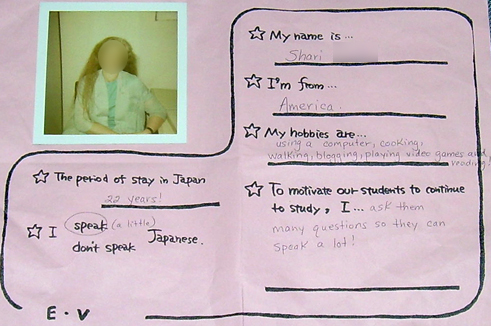
My teaching profile sheet from my last job at an eikaiwa (conversation school). 

Hands down, this is the one thing that I can say without reservation has gotten harder to bear over time. My relationship with my students was not one of friendship or scholarship, but more of a therapeutic one in which I largely functioned as a counselor and they as clients. The biggest part of good therapy is that you listen respectfully, attentively, and with empathy and get people to talk about themselves as much as possible. The biggest part of good conversation teaching is that you listen respectfully, attentively, and with empathy. There is a bond of trust that you build over time that cannot be easily replicated in any other relationship. From my point of view, the teacher and student relationship was better than that of a client and counselor because there was no expectation that I'd solve their problems, but only that I'd improve their English. The latter is a far easier task than the former, and with far less dire consequences if one fails.

The relationship I had with my students was close, deep, and authentic. I miss talking to them and knowing that I was helping them in multiple ways, and I doubt that will ever change no matter how many years pass since my departure from Japan.

Thursday, May 24, 2012

Will Miss #451 - bizarrely inappropriate English lessons

An infamous video lesson teaching people the phrase "I've got a bad case of diarrhea". 

One of the textbooks that I used to teach from had a lesson about slicing cheese. A waggish teacher crossed out "slicing" and changed it to "cutting". When the students did the pattern practice, they would mechanically talk about cutting the cheese as the teachers sat by and tried not to laugh. The thing is that this sort of strange English lesson wasn't confined to teachers altering the contents of low level English lessons. The Japanese distributors tend to include all sorts of weird English phrasing based on what they perceive to be important things to say and they do so without consideration for the cultural context of the cultures in which English is spoken. As I've said before, the Japanese can be refreshingly candid and open about bodily functions, but this can make for some pretty peculiar phrase practice when the origin of the textbooks or lessons is from Japanese distributors.

I'll miss these innocently funny and bizarrely inappropriate English lessons.

Wednesday, May 16, 2012

Won't Miss #449 - and, and, and


One of the things I had to repeatedly correct with my students when I was teaching English, both in writing and when speaking, was how to use "and". Despite what I'm sure are years of studying English grammar rules, students seemed to think that you should put "and" between each noun that you were stringing together in a sentence. For example, a student would say, "I have been to Italy and France and America and Canada and Hawaii.*" No matter how many times I would explain to students that you only need to say "and" between the penultimate and final noun, most would keep doing this persistently. I'm pretty sure they wouldn't do this so consistently unless their early teachings taught them incorrectly or their teachers failed to correct them. 

I won't miss correcting this persistent mistake, which should never have occurred in the first place had people been taught correct grammar by a native speaker rather than a Japanese teacher of English who implanted all of his or her errors in the language into the students. 

*Because, you know, Hawaii isn't part of America in the minds of most Japanese people. 

Tuesday, March 27, 2012

Won't Miss #432 - reassuring people about their English


Everyone knows the loaded question that women supposedly ask their husband's about a dress making them look fat. The idea is that whatever the man answers, he loses. If he says she does, she will be angry that he is saying she's fat and doesn't look good. If he says she doesn't, she'll say he's lying to make her feel better. The equivalent of that in Japan is the oft-made assertion, "my English is not good." Everyone of every level says this and it puts the native speaker in an awkward position position. If you say nothing or agree, you deny the obviously desired reassurance. If you disagree and say they speak (or at least communicate) well, there is denial that that is so.

I'm tired of feeling like I'm lying*, patronizing, or patting people on the back about their English abilities and I won't miss it. 

*I never lie to people about their English ability and level. However, I will often say that people are capable of communicating despite their limits when their level is low. This isn't a lie, because it is often true. Most Japanese people speak English enough for basic communication, and a great many more can do better than that if they believe they can.

Monday, March 5, 2012

Won't Miss #424 - being treated like a dictionary


My husband and I have played a certain video game for well over a decade. Part of this game is facing stacks of creatures with ambiguous descriptions of their size like "lots", "several", and "pack". There's a guide online that tells you the number each one of those represents and my husband learned what they meant long ago. As for me, I just ask him every time and never learned for myself. I mention this because if you have someone who will easily answer your questions rather than do the work of looking things up yourself, you have a much lower chance of retaining information. Because of this, I get very annoyed every time I teach a student and they treat me like a translation dictionary. They ask, "how do you say (Japanese word) in English?" They do this with an electronic dictionary in front of them or with a cell phone with a built-in dictionary tucked into a pocket. It irks me when they do this because I'm not there as an answer bot, but more so because I know that they'll never remember the translation if they don't find the information for themselves. Sometimes I end up translating the same word for the same person over and over again if I give in and just tell them.

I won't miss being treated like a handy dictionary for people who are supposed to be trying to learn a language and all too often seem to believe that spoon-feeding answers is an effective way to learn a foreign language.

Tuesday, February 21, 2012

Won't Miss #420 - talking to people in masks


I think it's quaint and somewhat endearing that you see Japanese people running around wearing surgical masks. It speaks to a certain meticulousness, paranoia, and, yes, even consideration for others. It's also the only way people ever seem capable of covering their mouths when they cough and sneeze. On the flip side though, there is an issue when they keep wearing them even when they are indoors and in a conversation with other people. In my work, it is not uncommon for people who are wearing masks to protect themselves from the swarming bacteria of crowded public spaces to keep them on while they share my tiny cubicle with me. I'm not the least bit offended that they want to protect themselves against "my germs" or those left behind by other students, but I really dislike the fact that I can't see more than half of their faces when talking. It's harder to read expressions and feels like I'm having a convivial conversation with a bank robber.

I won't miss talking to people who are wearing surgical masks. 

Tuesday, January 31, 2012

Won't Miss #413 - cutting/adding sounds

Sometimes I have to really reach for a picture, especially when I'm talking about sounds. So, we have this extremely tenuous connection here. 

One correction I've made to students' English about a million times by now is the addition of an "a" at the end of the word "salad". This is because Japanese, with a few exceptions, operates with consonant vowel pairs (e.g., ka, ki, ku, ke, ko, but not just "k") and salad is pronounced as "salada" in Japan. Prying the added sounds off the end of an English word that has been adapted to suit Japanese pronunciation is close to impossible (shirt and suit, are similarly difficult as they are perma-pluralized in Japanese as "shatsu" and "suitsu").

This side of the puzzle wouldn't bother me so much except that the Japanese seem perfectly capable of truncating these sounds of their own volition when it suits them. There's a department store called "Seibu" (pronounced "say-boo") which they almost always refer to as "Seib" (sabe). I've also heard people say "Shinjuk" for "Shinjuku".  It's a small thing (but did you actually expect 1000 big things about Japan?), but it annoys me that I can't get them to chop off sounds where necessary when speaking English, but they are capable of doing so in their own language when it isn't.

I won't miss this linguistic inconsistency. 

Wednesday, January 25, 2012

Won't Miss #411 - "Tarzan" speak


Some English teachers operate under the dubious philosophy that if they speak English poorly, their students with comprehension problems will have an easier time understanding. Sitting next to one of these teachers provides one with a steady stream of dropped articles ("a", "the", "an"), plurals that lost their s's, and adjectives subbing for adverbs. An example would be something like, "boy walk quick to store," instead of, "the boys walked quickly to the store." This sort of poor English speaking is only serving as a model of poor habits for the student and makes the teacher sound like a complete and total idiot. It does nothing to improve comprehension as few students are getting hung up on removed components of the sentence. Usually, their inability to understand is linked to vocabulary, listening only for keys words, or confusion about differences in Japanese and English grammar. It is not helpful to devolve into "me Tarzan, you Jane" grammatical patterns. 

I cringe when I hear a teacher speaking in this way, and I hear it all too often. I think it reflects poorly on English teaching in Japan and underestimates the Japanese. I won't miss hearing people who think speaking like a caveman is somehow helping their students learn. 

Thursday, December 1, 2011

Won't Miss #393 - using Japanese English


I don't mind if Japanese people use Japanese English (as opposed to "Engrish", which is a whole other kettle of fish) because it is understandable that they do. If I'm teaching them, I just point out that they shouldn't use it and tell them the correct words or phrases. Unfortunately, sometimes you find yourself being unable to make yourself understood unless you resort to using it yourself. At my former job, we used to ask people what their "outstanding feature" was in regards to their appearance. The Japanese translation that we were told to use, tokucho, was confusing because the students would answer about their personalities, not their countenance. The best way to get what you wanted was to ask the student what his or her "charm point" was because this was a Japanese English term that was popular at the time. Sometimes, when you've struggled to get your point across in English and then Japanese and have still failed, you find yourself resorting to using these terms and it always makes me feel bad for doing so. I'm supposed to be teaching proper English, not using weird phrases because it expedites understanding.

I won't miss how I feel like I've failed miserably when I resort to using Japanese English to make myself understood. 

Thursday, July 28, 2011

Will Miss #346 - teaching English (the good)


I've already written that I love my students, but that is because I currently mostly work freelance in a situation which allows me to work with people who are rather different from the general population of language learners in "eikaiwa" (English conversation schools). Because of my specialized circumstances, I have fewer of the passive people I mentioned in the previous post, and more active talkers. The truth is that I "moved on up" to an office job after being a teacher for a few years, but am happier having moved "back down" to teaching. From a personal growth and experience viewpoint, it is much more fulfilling. It's not only that I learn about people, but that a lesson that carries out beautifully from the viewpoint of material selection, pacing, energy levels, and tone is a thing of beauty, and I make it that way. I'm not a monkey teacher jumping around and acting foolish to entertain. I come across as "a real person" with my students, and they love that. And though it may appear effortless, it most certainly is not. Knowing when to listen, when to speak, when to wait, how to phrase a question, how to react, what topics to discuss with a particular student, etc.  takes a lot of skill. What is more, I often provide an emotionally therapeutic environment for students. Often speaking in English is more liberating for Japanese folks and they'll confess frustrations, opinions, and other feelings that they can't or won't share in Japanese. I'm sometimes told at the end of such lessons that the student came into the lesson stressed, and is leaving feeling lighter.

When a lesson comes off smoothly, elegantly, and at the end feels like I just spent a pleasant hour with another human being or when I know the interaction I've had with a student is cathartic and makes them feel better, I know I've accomplished something and done my job well. I'll miss that.

Wednesday, July 27, 2011

Won't Miss #346 - teaching English in Japan (the bad)


I've already written about the bad attitudes and misconceptions some people have about teaching in Japan, but there are negative aspects associated with it that have to do with the work itself. Foreigners who once taught but moved on to other jobs look down on those who remain in that work because they think it's a job that requires no skill. It requires a lot of skill to do well, but many people undermine the value of that skill because it is not linked to knowledge of linguistics, but rather is linked to social ability. The truth is Japanese people don't need a grammar teacher. They all have very good book-based knowledge of English from high school. They need real practice.

One particular problem with teaching in Japan is that Japanese people, on the whole, are passive so they require a great deal more energy to engage, and this all the harder when they speak English at a low level and have limited capacity to communicate. There is also the fact that teaching is relentlessly engaging with the student peering expectantly at you for the duration. English conversation lessons are a marathon of social obligation and pressure to keep the conversation going, but not at the expense of the student's opportunity to be the person who is speaking most of the time. When it's bad, it's like doing an hour-long interview with someone who gives dismally short replies but with whom you must be infinitely patient, gentle, and kind as a facilitator of the conversation. Anyone who thinks doing that well is "easy" is being willfully stupid or a liar. It's not merely sitting down and chatting freely as if you were with a friend. It's often chatting with a timid and conversationally unhelpful friend and not having the option to simply end it and walk away.

With a certain type of student, teaching English can be very draining and difficult and I won't miss it.

Thursday, August 26, 2010

Won't Miss #224 - (s)Mothers and kyoiku mamas

Disclaimer (aka, please do not sue me): I'm not saying this lovely woman with her daughter is a kyoiku mama or overprotective because she's holding her little girl close. This is just a picture taken at a shrine on New Year's of a parent and seemed to fit the very general theme and is not meant to imply anything about this fine woman's character.

Though I have never been held hostage as part of a captive audience by an overenthusiastic parent, there are some problems with mothers in Japan, particularly if you are a teacher. Some mothers are over-involved with their children's lives to an unhealthy extent, particularly their education and any aspect related to their academic careers (like club activities). There's a term for women who relentlessly push their children to study, kyoiku mamas, and there are also women who simply insert themselves where they don't belong as part of their kid's education. Some mothers insist on standing at the back of the classroom during every lesson and interfere with lessons. Some of them dictate every little action to the teachers or bully or intimidate them. I once taught a mother who clearly dragged her son along to her English lessons and then dominated the lesson by translating for him and even incorrectly "correcting" his English instead of allowing me to do my job.

I won't miss these women who are so controlling with their children that they push them and me around.

Saturday, July 17, 2010

Won't Miss #203 - working weekends


 I know a lot of people feel that English teachers are the career bottom feeders of Japan, but the truth is that I'm much more satisfied teaching English than I ever was in my 12 years as an office-dwelling wage slave pushing around papers and staring at a computer screen. There is, however, one drawback to being a teacher and that is the necessity of working on weekends. Most people who study English are students or employed. That means that they can really only take lessons comfortably on weekends so you have to meet the needs of their schedules. While I generally don't mind working on weekends, I sometimes feel out of sync with the rest of the world who are at play while I'm at work.

I won't miss working on weekends.

Wednesday, July 7, 2010

Will Miss #197 - cultural story exchanges


English language schools ("eikaiwa") and foreigners working in them get a bad rap among the foreign community in Japan, but I can say without hesitation that they are the best cultural exchange environments around. A big part of the reason for this is that foreigners who are studying Japanese tend to want to speak mundane Japanese for practice outside of the eikaiwa, and those who work in an office no longer find the environment appropriate for certain types of conversations. Another reason is that the point of eikaiwa lessons is to get students to talk as much as possible, and a lot of territory gets covered to keep the topics fresh, so you find yourself talking about a broad diversity of themes. I learn more about Japanese culture, both past and present, from teaching English than I ever did while working in a Japanese company. One of the things that I frequently hear about are the old stories that form the backbone of the shared cultural experience in Japan. The stories we know from our childhood are different, and it's interesting to see some marker of our stories (like the Lady Godiva icon on Godiva chocolate shops) in Japan and to explain the underlying meaning to Japanese people as well as to have them tell their culturally shared stories.

Sharing these types of stories is a big part of appreciating the charm of each particular culture, and it goes some way toward understanding the values instilled in people from childhood. I will miss that.