Showing posts with label won't miss. Show all posts

Tuesday, July 1, 2014

Won't Miss #544 - emergency call fear


One of my greatest fears in Japan was that something would happen and I'd need to call for the police or an ambulance. Communicating in a foreign language can sometimes be trying in the best of times depending on the context, the person you're speaking with, and the vocabulary required. Doing so in a situation in which one is in a panic is almost unimaginable. If there is ever a situation in which you won't be able to get your head straight, it's when a loved one is lying unconscious on the floor.

I'm very happy that nothing ever happened which required me to call for emergency services in Japan and I don't miss the fear that occasionally popped into my head at the notion of having to do so. 

Tuesday, June 17, 2014

Won't Miss #56 - slow payers (reflection)


During my twenty-three-year absence from the U.S., a new way of doing business popped up. It became possible for people to do something which I never imagined that they'd allow them to do. That is, they could check themselves out at the register. In fact, there are some places which only do self-check-out ("Fresh & Easy"). At first, I found the prospect intimidating. Now, I wish every store had that option.

The reason that I love self-checking out is that it means I don't have to wait behind some granny or grampy who doesn't seem to understand the fact that money will have to exchange hands at the end of the transaction. The idea that the logical conclusion of events should also be preceded by the removing of ones wallet from a bag or pocket also seemed to come as a shock to many customers in Japan as they only reached for their cash when the checker had his or her hand (or cash tray) out and asked for it.

There are still slow payers in the U.S., but the use of debit and credit cards as well as self-check-out makes it less frequent and offers a way to get around such people. I certainly don't miss the slow paying people who seemed to always be in line in front of me in Tokyo. 

Tuesday, June 10, 2014

Won't Miss #543 - "Japanese food is healthy"


One of the things you notice about not living in Japan is that people aren't nearly as interested in talking about it. That means that I no longer find myself hearing comments about how Japanese culture is superior in this way or that way on a regular basis. One of the highest grounds that people tended to occupy when it came to expressing how much better Japanese culture was than others (usually American, because everyone knows America is a horrible place full of horrible people who do and produce horrible things) about how the cuisine was so incredibly healthy. To hear my students talk, Japanese food never strayed from the fish, tofu, rice, soup, and vegetables that most Western folks believe make up the core of the Japanese diet. The truth was that the Japanese diet consisted entirely of those items in the same way that American diets consist only of burgers, fries, and pizza. People in neither country consume stereotypical meals.

The stickiest point for me when it came to how supposedly healthy Japanese food was was the enormous consumption of white rice. In the U.S., if anyone ate so much of a white starchy food, the food police would cuff them and take them in for blood sugar crimes. In Japan, it's somehow the core of a "healthy" diet, and Japanese people almost universally eat white rice. Brown rice is only consumed because people are sick or if they are following an atypical diet. I also found that consumption of fruit and fresh vegetables was shockingly low (as was the drinking of water). If you don't believe me, do a web search on images of Japanese bento and see how ornamental fruit and vegetables are - a few grapes here, half a strawberry there, a cherry tomato or three here and there, a few slices of flower-shaped carrots. Mostly, it's rice, fish, and, if there's a salad, it's a bit of shredded cabbage drenched in mayo or thousand island dressing.

At any rate, as someone who saw and talked about what people actually ate, and who had to struggle to find and pay much, much more for anything that was brown (bread, rice, pasta, etc.), I found the claims of how healthy the Japanese diet was in terms of composition over-rated. Frankly, I think the diet in Japan is better because of portion sizes and variety - not because all of the food is so much healthier on the whole. I don't miss hearing people pompously assert how healthy the Japanese diet was.

Note to commenters: This is not a pissing contest. It's not about "Japanese food is healthier than (other country's food)," but whether or not the Japanese can universally and smugly claim their diet is "healthy". If you want to simply say, "X is better than Y," then you already "win." Congratulations.  Your comment will not be necessary. 

Tuesday, June 3, 2014

Won't Miss #55 - hanko (reflection)


For those who don't know, a "hanko" (or inkan), which used to be referred to as a "chop" by Western folks, is a little seal that you apply ink to and use instead of a signature. In Japan, many families use them to "sign" official documents instead of writing their names. You can get them made for fun, but to use them for banking or contracts, you have to have a registered hanko (jitsuin). They're more expensive and you have to go through some bureaucratic rigmarole to get it squared away... and who needs more of that, especially in the land of red tape?

Every time my husband and I did something official (banking, money exchange, work or rent contracts), we were asked to present our hanko. We never had a hanko and refused to have one because we viewed it as a security risk. It was rare, but it did happen that people's bank books and hanko were stolen on occasion. If someone has these two items, they can go to a bank and take out money from your account. The idea that I could lose or have my "signature" stolen was one I couldn't overcome.

I tried hard to see the value of all aspects of Japanese culture. My guess is that the use of hanko was something that made sense as a way of allowing all family members to manage official documents, not to mention that it probably allowed for a uniform comparison of seals and permitted illiterates to still apply their mark to papers back when more people could not read or write. It no longer makes a great deal sense to use them, but they are still used. Sure, there's a certain "cool" factor because of the novelty in Western minds, but would you really want to have something which would function as your official legal sanction rolling around in a desk drawer or at the bottom of your handbag?

I still don't miss being asked if I have a hanko, and having to sign my name in the tiny little circle where the stamp was supposed to be made when I revealed that I didn't have one. 

Tuesday, May 27, 2014

Won't Miss #542 - simplistic and ineffective therapy


Recently, I watched a video lecture about a mental health issue in which an international audience was present. After the presentation, members of the audience were allowed to ask questions or make comments. When it was the turn for a Japanese audience member to speak, his comment about the fact that optimists suffered less degradation in their bodies than pessimists was, 'so you're saying we should just smile all of the time.' He said this without irony and it was clear that he felt this was a correct conclusion to reach. This overly simplistic conclusion coming from a Japanese person in mental health did not surprise me in the least.

While I was in Japan, I learned a bit about various mental health entities there and their methods of treatment. The national health system generally allows people to only have sessions that are 20 minutes in length which doesn't allow much time for treatment. Of course, they probably don't need much more than that because, in many cases, the first line of assistance for people who have contacted someone who is a qualified professional is to be told to take a walk, look at pretty flowers, and smile more. These things are not a bad idea, but "just cheer up and get out" is not the sort of advice that I would want to get if I was in a sufficiently bad state to make the effort of going to a psychologist or psychiatrist.

Considering the high suicide rate, you'd think Japan would have a large task force figuring out the best way to help people with their issues, but there are still no small number of people who think that it's just a matter of turning that frown upside down, taking the time to smell the roses, or pulling yourself up by your bootstraps. It's no shock to me that one of my coworkers was away from the office for an entire year with depression considering the shockingly ineffectual manner in which mental health is sometimes managed in Japan. I don't miss the stupidly simplistic (and potentially damaging) way in which "therapy" is carried out. 

Tuesday, May 13, 2014

Won't Miss #541 - gaijin baiting


A long time ago, when print newspapers were still relevant, I subscribed to a paper called "The Daily Yomiuri." This was the English equivalent of the far more popular "Yomiuri Shimbun". I chose this paper not because it was the best, but because it was the cheapest and news in English was hard to come by in the pre-internet days.

One of the things that started happening in this magazine was that they started printing letters and editorials by someone who went by the name "Roy MacGregor Hastings" (or "Hasty" - my memory is a little fuzzy). I'm pretty sure this was a fake name and that the articles and letters were just as fake. Each one was full of nasty, bizarre stereotypes about Americans. One of the more memorable ones talked about how they'd weep into the vegetarian dish cloths while eating their brown rice or some such odd talk. These days, I'm sure that this creature would write about being fat, owning guns, and eating junk food.

At any rate, this was my introduction to something that I saw the English press in Japan do on occasion which irritated me greatly. That's okay because their intention was to piss me and other readers off. I think that some of them intentionally baited the foreign community to get them more engaged with these small circulation publications in an effort to improve sales or, at the very least, inspire enough passion to get more letters. While my most memorable experience with this was with the Daily Yomiuri (and I got so sick of it happening that I canceled my subscription and swapped to "The Asahi Evening News"), I saw it happening in other publications as well.

These days, it tends to happen more online than anywhere else. In fact, it happened to me with one of my former blogs in which a content aggregator (the bottom feeders of the blogging world) pitted something I wrote against a reply someone else wrote. The main problem was that they outright lied and distorted everything I said in my post to ramp up the potential conflict. A plethora of comments put me down while just one person who had actual reading comprehension said, "this is NOT what she said!"

I don't miss this way of baiting the foreign community by planting (almost certainly fake) incendiary stories in order to rile people up. It was and is a cheap way of getting readers and attention and it fractures a community that desperately needs to offer its members more support. 

Tuesday, April 29, 2014

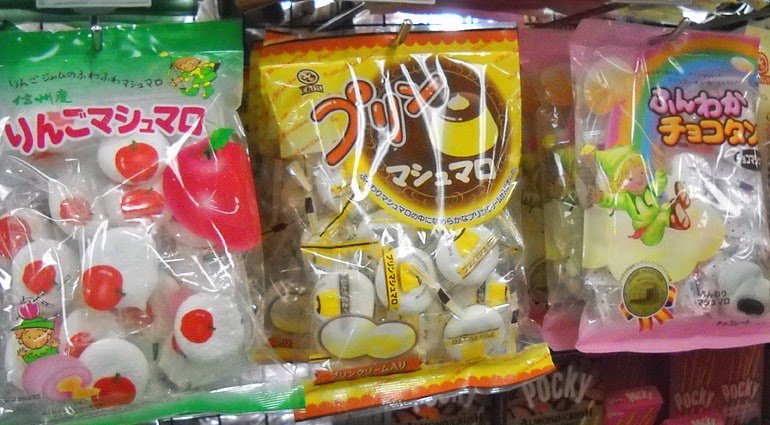
Won't Miss #540 - Japanese marshmallows


I haven't celebrated Easter for quite some time because I have learned that there are greater costs to eating sweets than the impact on your wallet. Every time I have seen Easter candy here in America, I have thought about how the idea sounds better than the treats will taste. That being said, I have always loved all things marshmallow and occasionally will indulge in them here. I've even found that there are lots of different flavors now that you can enjoy in various ways. I've used the holiday gingerbread marshmallows for rice krispies treats and the pumpkin spice ones in hot chocolate. These are yummy treats.

In Japan, there are also variations on marshmallows, but there is something wrong with how they work. Flavored marshmallows are generally filled with goo. This can be good, or it can be quite a bit less so. The main problem is that they are sticky, don't melt properly, and have a texture which is a bit stretchy or rubbery. They also sometimes have a funky aftertaste. I never tried to use them in marshmallow treats (as finding rice krispies was never easy), but I did try them in hot chocolate and they just sort of sat there vaguely melting, but not doing what I expected of them.

It is a small thing, but life is composed of delights both tiny and gross, but I didn't like the marshmallows in Japan and I don't miss them.

Tuesday, April 1, 2014

Won't Miss #538 - the bacon


Having done over 1000 posts (Blogger tells me 1285 at this point), it is difficult at times to remember what I have and have not said so I try to double-check my past posts to see if I've already mentioned a particular topic. When it comes to this particular topic, I cannot believe I had not wrote about it before.

For the duration of our stay in Japan, my husband was disappointed in the bacon. He's not an enormous bacon eater, but he does like to have a bit now and then. Compared to most American appetites for bacon, frankly, he's a super lightweight. When he does eat it, it's never more than 2 strips and he only has it once every week or two. Nonetheless, when he wanted some in Tokyo, it always tasted like disappointment.

The main issue with bacon in Japan, in our experience, was that it generally was not cured well. It tasted more like plain old pork - what my father used to refer to as "fresh side" - rather than bacon. There's a sweet and salty quality to bacon that generally was missing in Japan and we (especially my husband) do not miss it.

Tuesday, March 25, 2014

Won't Miss #41 - willy nilly food serving (reflection)


I can't say that I have eaten in a lot of restaurants in America, but I have eaten out about once every month and a half for the past two years. In all but one case, everyone at the table was served their food at the same time, and, unsurprisingly, that was at a Japanese place. For a culture in which people do everything together, I'm surprised that nobody cares if everyone gets to eat at the same time at the table. Food is served whenever it is convenient for the servers and the kitchen rather than in accord with the customers' needs or desires.

I don't miss sitting down to eat a meal at a restaurant and finding that I was eating 20 minutes before my seatmates because the kitchen and wait staff couldn't be bothered to coordinate. 

Tuesday, March 18, 2014

Won't Miss #537 - mold

The wall behind my washing machine - it turned nearly black with mold that grew in warmer months and died in colder ones then came back around again the next year.

During my first year in Japan, one of my coworkers told me about how mold seemed to spring up everywhere in his apartment. He told me that a pair of shoes that he left in his genkan (entryway) had even seen a crop of the stuff take up residence. When I expressed that that sounded incredibly gross, he said it was no big deal and that "mold is a gentle creature" and he just wiped the stuff out of his shoes.

My previous post reminded me of something I would have rather forgotten. That is, the ease with which mold tended to take hold in Tokyo. I can speak for every single place in Japan, but I can say that mold seemed inescapable in the humid sub-tropical weather there. It did not matter how well we ventilated our home. In fact, it was so poorly insulated that there was no way to make it anything but drafty both against the summer heat leaking in and the frigid cold in winter.

I grew up with relatively humid summers in Pennsylvania, but we never faced the sort of mold that I encountered in Tokyo and I absolutely do not miss it.


Thursday, March 13, 2014

Will Miss #536 - having a laundry hook-up in the apartment

The beige tray on the left (under the water spigot) was the home of my machine for more than two decades. You can see that there are disadvantages - mold developed on the walls behind and in front of it from moisture (both from the machine and the bathing area behind that door). Those trash bags were the things we were tossing out when we were vacating the apartment. It's not garbage so much as possessions that weren't worth carrying back to the U.S.

Prior to spending most of my adulthood in Japan, I had not lived in a truly independent fashion. I spent 23 years in my parent's house and then a year in California in my husband's best friend's house. The ease of living in a house was something that I took for granted. I had never rented my own place in the U.S. so I had no idea how that all tended to work when I returned to the U.S. at the age of 48. One of the surprises in store for me was that most apartments, at least in the Bay Area, don't have their own laundry facilities or a space in which one can set up a machine.* You have to rely on public or communal apartment (pay laundry) machines. Though the apartments here are bigger inside, people seem to prefer filling that space up with their crap instead of having the convenience of on-site laundry capability.

In Japan, there was space in my apartment for a washing machine. It had a plastic shell and a built-in drain. It was in the space next to the area with the tub and shower so I could recycle water from the tub if I wanted to by putting it in the washing machine. After spending some time back home dealing with the hassles of public laundry facilities which often consume my quarters without offering full service (either because the machines malfunction or the dryers are anemic), I truly miss having the ability to just toss my clothes into a machine any time I want. 

*Note: I know I can buy a portable washing machine and manually hook it up to a sink. However, this is not the same as having a dedicated space with a drain and water faucet. Lugging a machine back and forth and connecting it to the sink is not something I want to be doing - not to mention I'd still have to use the laundry room's dryer since there's no space for hanging clothes up to dry in most of the apartments here.

Tuesday, March 11, 2014

Won't Miss #49 - frozen construction (reflection)


As I mentioned in the original post, my issue with construction which took forever to complete was that areas that I had to walk through were often obstructed by it. In particular, it seemed to take forever for any work being done on stations to be completed. The question as I look back on that situation is, "does it take forever in America, too?" The answer to that is definitely "no". In the U.S., the problem isn't that construction never gets done, but that it seems to recur quite often, especially on roads. 

So, while I might have to walk through a taped-off, walled-off, narrow space for over a year in Tokyo while construction seemed to proceed at a crawl, I didn't tend to have to do it more than once in a long span of time. Nonetheless, I don't miss having to walk around or work around glacially paced work.

Tuesday, March 4, 2014

Won't Miss #536 - fear of being arrested

I don't think having your picture taken with the police mascot would have been an arrestable offense, but I wouldn't take any chances.

Early on in our time in Japan, my husband and I knew that the Japanese police could hold you and disallow contact with the outside world entirely if they chose to do so. "You" means "foreigners", of course. This could happen for no reason at all or for something trivial like if one of us happened to step outside for a moment without our gaijin cards and a policeman was walking by. This was an oddly not uncommon experience in my neighborhood as they seemed to go around to the houses not infrequently). In theory, a police officer could refuse to allow us to step inside our apartment to get our I.D. and show it to him. He could haul us off to the local police station and hold us until someone brought the gaijin card. Oh, and they don't have to let you call someone and ask them to bring it.

So, my husband and I had an agreement that, if one of us seemed to vanish, we'd start with going to the police station to see if one of us had nabbed and disallowed a call. Does this sound far-fetched? Yes, it was unlikely, but it did happen to people on occasion - yes, even white people. It was one of the first things I was told about and warned against when I arrived in Japan in 1988.

I don't miss fearing that I'd be arrested and held without the ability to contact my husband and let him know what had happened to me - small as that chance may have been.

Tuesday, February 25, 2014

Won't Miss #48 - instant dust (reflection)


When I was growing up, my family lived in the boonies. Well, speaking more accurately, we lived in the midst of strip mines. I mean that quite literally. There was a coal tipple about a five-minute walk in one direction and sludge ponds and processing machinery as well as a cargo train loading area about a ten-minute walk in the other direction. Enormous coal trucks rumbled up and down the dirt road next to our house all day, nearly every single day.

This situation kicked up loads of dust. My sister had asthma and my mother was constantly calling the people in charge and yelling at them to oil or water the road to keep the dust down. Our house, when the windows were open, was always instantly covered in dust from the kick-up. Eventually, the roads were paved, which brought on a whole other problem in winter when they became icy and slick and our cars couldn't get out of the driveway without sliding down the steep hill that our house was situated on.

In Tokyo, it wasn't quite as bad as it was at my home, but I recall more than one day in which I dusted and could run my finger through a fresh layer of dust by the end of the day. Part of this was the pollution in the air, but another part of it was the construction of the apartment and living on the first floor. The entire place was made with materials that seemed to be deteriorating at a rapid pace, and the not infrequent earthquakes were just making it worse.

Where I'm living now, it actually takes days for dust to appear. It's the first time in my life that I've lived in a place in which I'm not having to wipe down surfaces on a daily basis or risk a thick blanket of dust forming in a short time. I still don't miss the "instant dust" that I experienced while living in Tokyo.

Tuesday, February 18, 2014

Won't Miss #535 - "home party"

This isn't a festivel. It's an "outside party".

Sometimes, you are irked by something not because there is any reason to be so, but just because you have some idiosyncratic and utterly illogical response. The use of the words "home party" to describe what is essentially a common get-together with friends at ones home in America used to really annoy me. I knew that this was a Japanese-English invention meant to explain something that was not common in their culture, but it always made me think that the Japanese believed Americans were having a grand old bash on a regular basis with their friends. The more annoying things was that I could not break students of the habit of using "home party" and replace it with the more appropriate "get together".

I don't miss students telling me that Americans have "home parties" all of the time.

Tuesday, February 11, 2014

Won't Miss #47 - air conditioners set for reptilian biology (reflection)


I knew when I returned to the U.S. that I would not be finding myself walking into markets and sweating. I also experienced more than one student who told me that they didn't like shopping in America because the shops were always "freezing". I dismissed this as the typical Japanese female sense that any temperature lower than 80 degrees F./27 degrees C. was downright Arctic. Well, I was wrong.

I was shocked when I returned and found that the markets here really are freezing a lot of the time. It was not like this when I lived here prior to my move to Japan. I'm not sure what is going on, but the rather grimmest of ironies is that the Asian markets including the Japanese ones that I frequent are the coldest markets of all. I cannot explain this turn of events, but I can say that my husband hates to be hot and often freezes me out in the summer with the air conditioning, but even he gets too cold in the frosty markets here. He actually had to step out of a Chinese market once due to the discomfort level.

So, while I hated the extremely hot spaces in Japan (and the setting of thermostats in summer to temperatures which were quite hot), I'm not sure that I'm experiencing any better here. If I had to choose between roasting or freezing (not a great choice), I guess I'd have to say it's still better to be too cold because you can wear a sweater, but I am thoroughly baffled by the extremes. I don't miss the hot shops in Japan, but I'm also not a fan of the frigid ones here either.

Tuesday, February 4, 2014

Won't Miss #534 - melon-flavored stuff

Yes, even melon gum.

Recently, my husband and I visited a local confectionary (See's Candy) because he wanted to buy their strawberry truffles. I love strawberries, but I'm generally not a fan of anything that is not an actual live berry. In fact, I found the truffles pretty vile and he loved them.

For me, this is a common pattern. I love the fruit, but hate things flavored with it. The exceptions to this tend to be orange and cherry. Both work better in sweets for me than things like banana and strawberry. One of the things which I experienced in Japan, but is not common here is the bastardization of melon in this fashion. I like melon, but I hated the vile melon concoctions in Japan. From melon-flavored sodas to pastries with disgusting melong filling to melon ice cream, it all just tasted pretty awful to me. 

I won't miss the melon-flavored options that were so frequently available in Japan.

Tuesday, January 28, 2014

Won't Miss #46 - washing in cold water (reflection)

My old laundry machine in Japan - and it was actually a fairly modern one!

The first time in 23+ years that I was faced with an American washing machine, I was stunned by the buttons that allowed you to make choices about water temperature. I'm sure that our washing machine when I was growing up had such choices, but I frankly did not pay any attention to them at all. In my youth, laundry was hardly a primary concern - unlike now when it's something I have concerns about so that I don't end up ruining my clothes.

One interesting thing about the option to choose hot, cold, or warm water wash is that there is a risk of wrecking something. The default cold water wash in Japan meant things didn't get as clean as they might, but it also meant I never had to worry about mixing colors and whites because there was little risk that one would bleed into the other. In fact, I rarely sorted my laundry when I lived in Japan for this reason.

Still, despite the lack of risk of turning all of my husband's shirts pink by including a red shirt in the mix, I hated the way in which the laundry was freezing cold and wet when I removed it and had to handle it for prolonged periods of time in winter. With no central heating and very cold and wet things, this put my fingers at risk.

I still don't miss only being able to wash my clothes in cold water.

Tuesday, January 21, 2014

Won't Miss #533 - fear about retirement


One of the things that we all have to face as we get older is how we're going to look after ourselves in our old age. No matter what country you are in, this is something of concern. My husband and I saved a fairly decent nest egg (which we are now using to pay for his graduate school and life expenses) while in Japan, and no doubt that nest egg would have continued to grow had we stayed in Japan and continued to save money. That being said, it would not have been the same as having an actual pension or social security.

Part of the problem with living in Japan for foreign folks is that you have to pay into the pension system for 20 years in order to get anything out of it. My former company, at which I had worked for 12 years, ignored the law in regard to the foreign employees and did not pay into pension plans or the government retirement program which is equivalent to social security. Had they done so, I'd have been able to transfer that and accrue Social Security in the U.S., but I didn't even know that they were breaking the law until the company was acquired by a more lawful one 10 years into my employment there.

The specter of what was going to happen when we were too old to work was always with us. We both knew we'd have to return to the U.S. and work there to get something in order beyond our savings. I don't miss worrying even more about retirement as a result of being in Japan. 

Tuesday, January 14, 2014

Won't Miss #45 - pitifiul economies of scale (reflection)


Now that I'm back in the U.S. with access to all of the types of sales that are common here, I conceptualize what it means to be able to buy a lot of something in order to get it cheaper. One of the common sales here is at Safeway supermarket at which I can buy cases of soda for about half the usual price during sales. They tend to do a "buy 2, get 2 (or 3)" free deal. Sure, we have stacks of soda sitting around for ages, but there is an enormous price advantage.

What I have realized is that, except on the rarest of occasions, the economies of scale gain isn't really worthwhile for a "family" of only two people. You can often buy a dozen donuts for a cheaper price than each donut individually sells for, but the two of us can't possibly consume them (and our freezer space is too precious for such an indulgence). Given the small sizes of things in Japan, economies of scale were actually more useful there than they are here.

It turns out that economies of scale sounded a lot better in theory than in practice and it's not really an issue here... either that or it was an issue there and only there. Either way, it doesn't appear to matter anymore.