Showing posts with label public transportation. Show all posts

Thursday, May 15, 2014

Will Miss #53 - getting around by bike (reflection)


America is well-known as a country in which car use is the norm. A lot of people criticize this as wasteful, indulgent, and selfish. However, it's important to know how geography and history dictate how people get from place to place. In New York City, for example, many people don't have or use cars because there is adequate public transportation and high population density. The rest of America doesn't have cars because they want them so much as they live in circumstances which offer them little reasonable option. That is, they either have no or terrible public transport and/or things are too spread out. Americans didn't plan things this way. It has to do with how our history unfolded.

In my current situation, I'm in between the "must have a car" and "can live without a car" life. There is some public transport, though it is expensive, inconvenient, not particularly reliable, and painfully infrequent. It is, surprisingly, pretty good about trying to accommodate cyclists. Many roads have lanes for cyclists and motorists are supposed to share lanes with them. For a suburb, it's probably more cyclist friendly than other areas.

Unfortunately, all of this really isn't "enough". This is mainly due to geography. Everything is still pretty far apart and riding even in bicycle lanes is not easy. There have been many cases where cyclists have had to move with the flow of traffic in a way that makes me nervous as a passenger in a car and I couldn't imagine feeling comfortable with as a cyclist. The irony is that, in CA, it's illegal to ride on sidewalks, but there are very few pedestrians and wider areas in which to negotiate a bike. There is every reason to allow cycles on sidewalks, yet you have to be in the street.

In Japan, I felt a lot more comfortable with the prospect of cycling and I still miss having that particular atmosphere and those riding conditions despite the drawbacks of limited parking and sometimes crowded sidewalks.

Tuesday, June 18, 2013

Won't Miss #23 - bigoted taxis (reflection)


I'm going to say something which probably sounds a little crazy, but bear with me. When I fill out a survey here in the U.S., and I do so more often than you'd think, I feel like I've somehow failed as a person when I have to check the box which says "white/Caucasian". Since I have returned, I've had "white privilege" tossed in my face so many times that I feel like I've done the part of America that gets to check other boxes a huge disservice by virtue of having been born with my particular genetics. I want to say, "please forgive me, I didn't choose this skin color!" Such is the life of a person living in a liberal state which makes sure to throw it in the faces of the "privileged" as often as possible that they are living lives of ease and comfort that others do not. There is a presumption that I can't possibly know what it is like to live as a minority and that I need to be "educated", and it needs to be happening constantly, to make me understand

My skin color means I can't possibly "know" what it's like for police to follow you and question you without cause, for clerks to be rude to you, or for taxis that you hail to drive by you... except, you know, I can and do. However, I still get talked at like I didn't live for over two decades in a place in which about .56% of the population was not visibly Asian in appearance and I was treated like an alien who'd just stepped off the mother ship on a daily basis. 

The truth is that, having been snubbed by businesses in Japan, I know what it is like to be on the other side. To the extent that I don't get treated that way now, I can understand the concept of "white privilege", though I quibble with the vocabulary choice. I think that what it really is is "minority disadvantage", but the words were changed at some point to make white folks feel like they're getting something they don't deserve and didn't earn instead of focusing on the fact that other people aren't getting something they deserve and shouldn't have to earn. It's meant to make one group feel guilty for what it has, rather than make that same group feel sorry for those who don't have something they should. Somewhere along the line, somebody figured making the majority feel bad created a better prospect for change than relying on their empathy and compassion for those who were being denied basic human rights and dignity. 

Because of my 23 years in Japan, I know what it's like to be treated like dirt because of your skin color, and the taxis in Tokyo that drove by when we tried to flag them down were one of the better indicators of that. I don't miss the way in which it made me feel like a lesser human being.

Thursday, April 4, 2013

Will Miss #18 - strange station art (reflection)


I've been on public transport relatively little in America, and that's because there is relatively little of such transport. What little "art" I tend to see related to such areas tends to be graffiti which has been scrawled by bored miscreants. While I do believe that some graffiti art is quite impressive, the vast majority is balloon words with faux depth and hastily scrawled words.

In Japan, because the train and subway stations are such a huge part of people's daily lives (at least in major metropolitan areas), they tend to be quite well kept and there is often an eye toward making them pleasant places to spend time. I saw the artwork and decor so often that I tended to only heed it when it was especially strange. Now, I have a greater appreciation for all of it rather than just the peculiar types.

The way in which art was used throughout Tokyo, even in areas which aren't necessarily the most glamorous, was an indication that there was a concern for making spaces more pleasant for everyone and I miss that attention to detail. 

Thursday, January 10, 2013

Will Miss #8 - convenient public transportation (reflection)


The biggest shock to my system upon returning to America has been the frustration of driving. I never especially enjoyed it, at least not in California, and now I find it really troubling. It could be that 23 years off the road have made me skittish, or that people really have gotten stupider and more reckless on the road. I suspect it is the latter because of higher levels of distraction due to all the little devices people can't seem to keep their hands off of like their cells phones, MP3 players, and GPS's. I know that I've seen quite a few people actually weaving around on crowded roads because they're too busy playing with their cell phones to watch where they are going. Frankly, I find it more than a little scary.

I've also found that, despite the fact that I hated hauling my shopping around in heavy backpacks, I miss walking to places most of the time. I have a sense that I'm somehow "failing" if I actually need to get in the car and go anywhere. I also find that things are far more boring in the suburbs in the U.S. because everything is massively spread out for car access. If you like to walk, and I really do, you're going to hard-pressed to do much more than walk over block after block of blandness.

The public transportation in Japan was not perfect, but it was very, very good. If I had to make a top 10 list of all of the things I miss about Japan, I'm pretty sure that it would be number one.

Wednesday, January 9, 2013

Random Memories #21

Click to load a larger, more readable image.

Memory is a funny thing, stranger than most of us realize. Unless you've been writing things down or recording them, there's a good chance that what you think was so was not really the case. This is not a new thought, but I do believe most people re-write history more often than they realize. Often, they do so to their advantage, but it's not uncommon to do so to one's disadvantage.

No one is immune to this sort of confusion, and certainly I am not. One example I came across recently was in regards to how I initially handled the transportation system in Japan. In 1989, when I went there for the second time, the time that started an unanticipated 23-year stay, I was terrified of the train system and got rather lost in Ikebukuro station the first time I exited the wicket from the Marunouchi line. I got turned around and went out the opposite side of the station and was very worried that I'd be late for my first day of work there. I remember arriving barely on time, and being hot, sweaty, and frantic. This memory, I'm fairly sure is true.

This was not the memory that I re-wrote, but there was another that got a revamp in accord with this later vivid memory of confusion and frustration. As a result of that experience, I grew very timid about taking trains in Tokyo alone (as opposed to with my husband) because I feared getting lost. As time went by, I told myself that I didn't really feel comfortable navigating the complex transportation system alone until relatively late in my stay in Tokyo. It turns out that that was far from the truth.

The somewhat phobic response to the train and subway system was written after that one "traumatic" experience Clearly, I had lost my confidence. I discovered recently that that was absolutely not the way it was during my first visit in 1988. I had zero recollection of the fact that I rode the subway from Kita-Senju to Shinjuku and other major shopping areas alone during the month I vacationed there and visited my future husband. Not only did I go to those areas alone, but I transferred between lines, exited stations, and went out shopping by myself. I know this because I said so in my own words on cassette tapes 25 years ago. 

While I was in Japan at that time, I made a tape for my sister in which I talked in detail about a lot of things that happened during my stay, but I never finished it and never sent it. It turns out my husband still had that tape in a collection of them that he had in storage all these years. I talk in the middle of my 1988 visit about things in close proximity to them occurring. It seems that, before that one scary experience, I was pretty brave about navigating the byzantine and illegible (to me at that time) public transportation system.

The map that I include with this post is of the system as it was 25 years ago. If you were to compare it to a map from this time, I'm sure you'd find that stations had been added and that all new lines are included (including the Fukutoshin line which was completed in 2008). The paper map itself is rapidly becoming an anachronism. Such maps used to be available in copious numbers at every station, but are increasingly reduced in quantity and availability. Most commuters use their cell phones if they need an overview of the railways, or, more likely, an online site which allows them to calculate the best way to get from point A to point B. If you've never used such software, it allows you to find several different routes on various lines and compare the time and cost for the best way to get from point A to point B.

These sorts of maps seem crude and inefficient by comparison to such software. They rarely included both JR (Japan Railway) and the Tokyo Metro (subway) since these systems operated in competition with one another. The software favors no line, and even includes buses. However, like many things in the digital age, they offer efficiency, but no tangible memento. It's just a piece of paper, but it serves to remind me of the fact that I once had a great deal more courage than I allowed myself to remember.

Thursday, September 13, 2012

Won't Miss #487 - wide stances


There are signs on Japanese trains telling people not to sit with their legs open wide because it is so common for men to sit as if it were imperative that they keep there knees as far apart from each other as a couple of angry, violence-prone weasels. My boss once expressed his frustration with these men by remarking that he'd love to ask them if their testicles were swollen. I am in no way exaggerating when I say that they are sitting to occupy the maximum amount of space possible on crowded trains. Japanese men seem to display this territorial body language much more often than men I've seen in America. Well, it's either the fact that they do it more often or I noticed it a lot more because in the context of the smaller, more densely packed areas of Tokyo, it seems far more inappropriate and selfish behavior.

I won't miss seeing these men who seem to believe they need to stake out a maximum amount of territory with their legs (or who suffer from some odd disorder in the cajones). 

Wednesday, July 25, 2012

Random Memories #2


The item pictured above is a subway ticket. Those who live in Japan now may see it as slightly anachronistic because most people use pre-paid cards like Suica or Pasmo. Tickets are still used, of course. You can buy one from a machine, feed it into an automatic wicket on the way in and have it sucked into the machine on the way out. Close observers will note three things which make this ticket and having a scan of it unusual in this day and age.

The first point is revealed in what I said in the first paragraph. At most modern stations, you don't get to keep the ticket at the end of your journey. In the old days, used tickets would sometimes be scattered around the area around the wickets because people would forget to leave them at the wicket and there was no demand that you relinquish it by the personnel manning them. You had to show it, but you didn't have to surrender it.

The second and third points can only be known to those who have lived in Japan for a long time. Old hands at life in Japan may want to take a moment to guess at what they are... OK, times up. :-)

One is that the ticket is for only 140 yen ($1.78). When I left Japan at the end of March 2012, the cheapest price for a ticket was 160 yen ($2.03). They didn't go any lower than that. Incidentally, this was a ticket for a relatively longish subway journey from Kita-Senju to Ikebukuro. I'm not sure, but I believe the cheapest ticket back in those days (around 1988) was 120 yen ($1.52).

The last significant reminder of the past on this ticket is the one that I associate most nostalgically with my earliest days in Japan. That is the little hole in the top. When I first visited (and lived) in Japan, the slick automated technology that is currently in use did not exist. There were men in dark blazers sitting or standing at the wickets with a hole puncher who would take your ticket and manually punch it and give it back to you at your departure point. This situation created an aural atmosphere that is now long gone. These men would continually click their hole punchers in a rhythm rather than simply wait for someone to hand them a ticket. This helped them more speedily process people, but perhaps it also relieved some of the boredom of sitting there with nothing to do or keep them entertained. Back in those days, they didn't even have continually updating digital schedules to flash shiny lights at them on a regular basis.

I realize that efficiency is important, but I rather missed that old human touch when taking the train or subway. It's not only that I know that men lost jobs, but also simply that sound is so important in memory. The little beep of a machine is sterile and artificial whereas the clacking of the punchers was a human rhythm which varied slightly with every man at the wicket.

Thursday, June 28, 2012

Won't Miss #464 - fear of being trapped on trains

It's higher than it looks here. 

When you live in Tokyo, you spend a fair amount of your life on trains. This is what happens when you live in a place with a very convenient, efficient, and punctual public transport system and very expensive parking. After the March 11, 2011 earthquake, my feeling about stepping onto a train changed. The trains automatically stop when a strong quake happens. If you are stuck on one between stations when one hits, it could be hours before you get out. They can't exactly open the doors in the middle of nowhere and have you disembark because the train platforms are very high (4.5-5.5 ft.) and there's no way to get down when you're not at a station short of a special ladder. In California, you go up steps to get on the train. In Japan, not so much. I talked to some people who were trapped on trains for as long as three hours during the quake and the answer to "what happens if you have to go to the bathroom" (as there are none on standard trains and subways). The answer was a shoulder shrug.

After the big quake, I was always afraid of being trapped for hours on a train or subway after a big quake and ending up soiling myself and I won't miss that paranoia.

Monday, December 26, 2011

Will Miss #401 - the blue lights


I live along a Japan Railway (JR) line that is famous for attracting suicidal jumpers. The line is named the Chuo line, and foreigners waggishly call it the "Chuocide" line because it so frequently is disrupted by those intent on offing themselves. JR obviously would rather this not happen, but rather than do what many subways have done and put up walls with electronic gates that disallow access to the tracks (unless you climb over a 4 foot wall), they've come up with a novel and greatly cheaper solution. They have installed blue lights at a few points along the platform because blue is supposed to be a soothing color which will make people think twice before taking a fatal leap. This is like putting a band-aid on a gunshot wound and expecting it to be sufficient remedy. 

Seeing these blue lights reminds me that silly, short-sighted solutions are a part of every culture, and I will miss seeing them and what they really represent; that is to say they reflect corporate stupidity rather than a commitment to dealing with a societal problem. 

Tuesday, December 13, 2011

Won't Miss #397 - pregnancy badges


One of my students once told me about an experience she had while riding the train. She was sitting with several other people when a family of three, mother, father and child, boarded the train. The woman from this trio started loudly sniping about how no one was forfeiting their seat for her despite the fact that she was displaying a badge that indicated that she was pregnant. Like many people on the train, my student was in her own world and didn't notice the badge. Indeed, it was hardly on prominent display, and the woman was not visibly pregnant. While I realize that some pregnant women may experience difficulties when their child is still embryonic (or indeed a few cells), I think that a lot of women use these badges to bully people on crowded trains into giving up a seat. In fact, I'm not entirely convinced that all of the women showing them are actually pregnant. To be honest, if you aren't visibly pregnant (i.e., not carrying much in the way of extra weight) and too fragile to stand on a train, perhaps you're too delicate to be on public transportation at all. 

I won't miss the women who act aggressively entitled to a seat because they are displaying these badges when they are not at a stage of their pregnancy which requires special accommodation. 

Friday, December 9, 2011

Won't Miss #396 - up the down and down the up


I've written before that context really matters in digesting experiences in Japan and I find it incredibly irksome when people break rules in Japan compared to back home. Part of the reason for this is the insistence by both Japanese and foreigners that the Japanese are so lawful and obedient. Another reason is that I get called on any tiny infraction of the rules, spoken or otherwise. I once got attacked by an old man who tried to shove me off my bike and the excuse some apologist made was "maybe you were riding on the wrong side of the sidewalk". There isn't even a rule about which side to ride on (though left is generally preferred), but this absurd reason was offered. And, you know, physical violence is definitely the proper response if someone is on the "wrong side", right? So, when Japanese people blithely ignore a rule and it means I'm put out, it gets on my wick.

Nowhere is it more common for Japanese folks to ignore the written rules than on the steps leading to and from train platforms. There are always arrows on the steps telling you which side is for ascending and descending traffic (as well as signs like the one above), but people constantly ignore them and then stand there blocking me if I refuse to move and accommodate their going in through the out door. I guess I should knock them down the steps because that is what is to be done when people are on the side you don't like if I follow the logic of apologists, but that's really not my way.

 I won't miss the way people consistently ignore which way is up and which is down on the train and subway steps. 

Tuesday, November 8, 2011

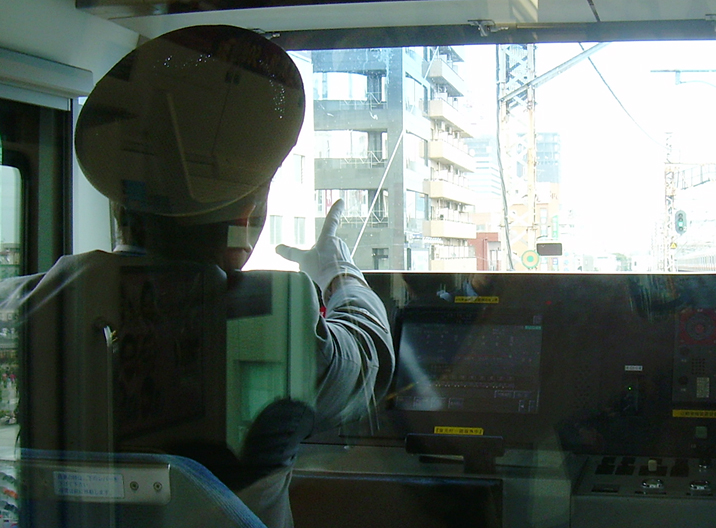
Will Miss #384 - watching the engineers


I don't know what it's like to run a train in America, especially in a metropolis like New York in which there is a large and complex system servicing a wide area. I can say that standing behind the engineer and watching how he operates when you get on a Japan Railway train is a pretty fascinating experience. He is sitting in there alone, but follows a very rigid routine of gesturing and movement. At first, I didn't realize why he pointed so often with his pristinely clean white-gloved hand then I realized he does so in recognition of signal lights. Even though they could easily not go through this routine out of view of other employees, they all do this because it's what they are supposed to do (and I'm guessing this sort of interaction keeps them alert).

To me, the way in which this work is meticulously followed by people in formal uniforms is a reflection of some of the best Japanese culture has to offer in terms of following a carefully carried out work ethic and I will miss it. 

Thursday, September 1, 2011

Won't Miss #360 - bags that need a seat


On all public transport around the world, I'm sure there are people who plant their bags onto an adjoining seat until someone comes along and needs to occupy that space. I don't mind if people do this on a relatively empty train, not that there are many "relatively empty" trains in Tokyo most of the time. However, there are people who flop their bag onto the next seat and as the train fills up, either refuse to move it or act as though you're ejecting a precious child overcome by exhaustion from a needed place to rest. They give you a dirty look and make a sound that clearly indicates disgust if you indicate (by hopefully hovering over the empty seat) that you'd like to trade places with their luggage.

I don't know if this is the result of "I don't want a foreigner to sit next to me and grudgingly will permit it" or if it is "I'm a selfish git who has no consideration for others" thing, but I won't miss people acting as though I'm seriously putting them out by expecting them to surrender a seat being occupied by an object.

Tuesday, August 16, 2011

Won't Miss #353 - being a leaning post


My former boss used to complain on a regular basis about something which happened to him every time when the train was crowded to sardine levels. That would mean this happened to him everyday during rush hour. Fortunately for me, it happens less often than that, but it still happens. When the train was extremely crowded, the people around him would simply stand without holding a strap and lean into him. They made little or no effort to support their own body weight when the train turned and just allowed their full weight to rest on him. This is one of the lazy and irritating things that happens on trains in Tokyo. The other thing that happens is that people who sit next to you will simply keel over and sleep on you.

I won't miss being a resting post for people who are inconsiderate, lazy, and rude.

Tuesday, December 28, 2010

Will Miss #270 - trains crossing closeby


I rarely rode public transport back home because I grew up in a rural area. My main experience with it was riding the Cal Train to San Mateo once a week and riding the Boston subway on a few occasions. The Cal Train were lonely and infrequent, so the experience of trains whizzing by within what feels like inches of one another at high speed carries a particular sense of excitement.

There's something about all of that kinetic energy and seeing the faces of hundreds of people in a different vehicle pass by at close proximity which feels rather unreal, and I'll miss that.

Friday, November 19, 2010

Will Miss #256 - air conditioned waiting areas

An enclosed waiting space (left) with air conditioning on the Keio line train platform.

Our last sojourn to Costco occurred in the humidity of the rainy season in June. The trip takes about 5.5 hours round-trip and requires a fair amount of train riding and some transfers. My husband and I were gratified to find the enclosed waiting spaces on the platform were air conditioned. They offered very welcome relief from the oppressive heat and densely humid air. They're also good for people who find the winter chill too much for them in the colder months.

I'll miss these comfortable and convenient waiting areas that act as oases of luxurious comfort on (some of) the open train platforms.