Showing posts with label food. Show all posts

Thursday, June 12, 2014

Will Miss #55 - mochi (reflection)


When I was 24 years old, I thought I was as smart as I was going to get. Seriously. I thought I'd had a lot of experiences, grown beyond a lot of my psychological issues, and that I had pretty much worked everything out. As I got older, I didn't get dumber, but I did come to realize that I wasn't nearly as worldly and knowledgeable as I believed myself to be.

One of the conceits that we tend to have when we're young, and many continue to have when they're older, is that they can understand the world from their particular perch. I learned in Japan that how you view the world, what you know and don't know, and the opportunities you have in life are influenced heavily by where you are. It's not enough to read about things. It's not enough to think or write or learn. Living it is always different.

When I wrote this blog originally, my conceptualization of my future life in the U.S. was based on the limited view of life in America that I had up to age 24. I didn't know that there were places in the U.S. which would afford me continues and copious access to Japanese food of various sorts. That possibility wasn't even on my radar, let alone living within a reasonable drive of a "Japantown". It turns out that I don't have to miss mochi, or a lot of types of Japanese food, because I can still get it here. I'm sure that, if I lived somewhere else, I'm sure I'd feel differently because my worldview would be colored by the limits I'd experience elsewhere. 

Tuesday, June 10, 2014

Won't Miss #543 - "Japanese food is healthy"


One of the things you notice about not living in Japan is that people aren't nearly as interested in talking about it. That means that I no longer find myself hearing comments about how Japanese culture is superior in this way or that way on a regular basis. One of the highest grounds that people tended to occupy when it came to expressing how much better Japanese culture was than others (usually American, because everyone knows America is a horrible place full of horrible people who do and produce horrible things) about how the cuisine was so incredibly healthy. To hear my students talk, Japanese food never strayed from the fish, tofu, rice, soup, and vegetables that most Western folks believe make up the core of the Japanese diet. The truth was that the Japanese diet consisted entirely of those items in the same way that American diets consist only of burgers, fries, and pizza. People in neither country consume stereotypical meals.

The stickiest point for me when it came to how supposedly healthy Japanese food was was the enormous consumption of white rice. In the U.S., if anyone ate so much of a white starchy food, the food police would cuff them and take them in for blood sugar crimes. In Japan, it's somehow the core of a "healthy" diet, and Japanese people almost universally eat white rice. Brown rice is only consumed because people are sick or if they are following an atypical diet. I also found that consumption of fruit and fresh vegetables was shockingly low (as was the drinking of water). If you don't believe me, do a web search on images of Japanese bento and see how ornamental fruit and vegetables are - a few grapes here, half a strawberry there, a cherry tomato or three here and there, a few slices of flower-shaped carrots. Mostly, it's rice, fish, and, if there's a salad, it's a bit of shredded cabbage drenched in mayo or thousand island dressing.

At any rate, as someone who saw and talked about what people actually ate, and who had to struggle to find and pay much, much more for anything that was brown (bread, rice, pasta, etc.), I found the claims of how healthy the Japanese diet was in terms of composition over-rated. Frankly, I think the diet in Japan is better because of portion sizes and variety - not because all of the food is so much healthier on the whole. I don't miss hearing people pompously assert how healthy the Japanese diet was.

Note to commenters: This is not a pissing contest. It's not about "Japanese food is healthier than (other country's food)," but whether or not the Japanese can universally and smugly claim their diet is "healthy". If you want to simply say, "X is better than Y," then you already "win." Congratulations.  Your comment will not be necessary. 

Thursday, May 22, 2014

Will Miss #541 - genkatsu


Some people like an enormous hunk of meat that they can sink their teeth into. I'm not one of them. The truth is that my bite is uneven and my mouth is also small. I have difficulty tearing things off and chewing well. If my parents hadn't been so poor, I guess I would have had some orthodontic work done and I'd be able to bite off a hunk of animal flesh with the best of them. At any rate, due to my issues, I prefer things that are softer and easier to manage.

I didn't actually count them. I took their word for it.

Genkatsu is a pork cutlet restaurant that has a special way of making their tonkatus. They don't take a slab of dead pig. No, they layer 25 thin sheets of ex-swine and bread and fry it for eight minutes for your enjoyment. The result is very tender, juicy, and flavorful. I don't know if those layers add to the flavor profile or not, but they seem to give the tongue more of a chance to linger on the meat - of course, that may just be my experience because I'm probably swallowing things without chewing them as well as I might and releasing their juices.

Beyond this specialty way of offering tonkatsu, they give you choices of side dishes, miso soup type, and sauces in a way which is not especially common for set meals. They let me choose yuzu koshoo sauce so, you know, I'm going to love them.

I miss genkatsu and their lovely customizable sets and easy to manage multi-layered pork cutlets.

Tuesday, April 29, 2014

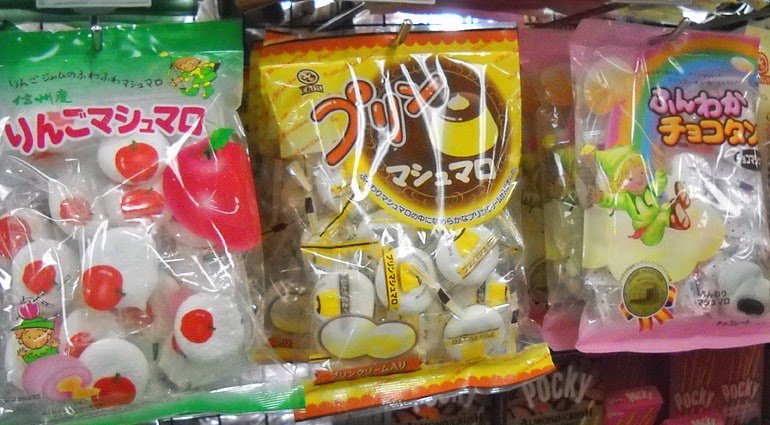
Won't Miss #540 - Japanese marshmallows


I haven't celebrated Easter for quite some time because I have learned that there are greater costs to eating sweets than the impact on your wallet. Every time I have seen Easter candy here in America, I have thought about how the idea sounds better than the treats will taste. That being said, I have always loved all things marshmallow and occasionally will indulge in them here. I've even found that there are lots of different flavors now that you can enjoy in various ways. I've used the holiday gingerbread marshmallows for rice krispies treats and the pumpkin spice ones in hot chocolate. These are yummy treats.

In Japan, there are also variations on marshmallows, but there is something wrong with how they work. Flavored marshmallows are generally filled with goo. This can be good, or it can be quite a bit less so. The main problem is that they are sticky, don't melt properly, and have a texture which is a bit stretchy or rubbery. They also sometimes have a funky aftertaste. I never tried to use them in marshmallow treats (as finding rice krispies was never easy), but I did try them in hot chocolate and they just sort of sat there vaguely melting, but not doing what I expected of them.

It is a small thing, but life is composed of delights both tiny and gross, but I didn't like the marshmallows in Japan and I don't miss them.

Tuesday, April 1, 2014

Won't Miss #538 - the bacon


Having done over 1000 posts (Blogger tells me 1285 at this point), it is difficult at times to remember what I have and have not said so I try to double-check my past posts to see if I've already mentioned a particular topic. When it comes to this particular topic, I cannot believe I had not wrote about it before.

For the duration of our stay in Japan, my husband was disappointed in the bacon. He's not an enormous bacon eater, but he does like to have a bit now and then. Compared to most American appetites for bacon, frankly, he's a super lightweight. When he does eat it, it's never more than 2 strips and he only has it once every week or two. Nonetheless, when he wanted some in Tokyo, it always tasted like disappointment.

The main issue with bacon in Japan, in our experience, was that it generally was not cured well. It tasted more like plain old pork - what my father used to refer to as "fresh side" - rather than bacon. There's a sweet and salty quality to bacon that generally was missing in Japan and we (especially my husband) do not miss it.

Tuesday, March 25, 2014

Won't Miss #41 - willy nilly food serving (reflection)


I can't say that I have eaten in a lot of restaurants in America, but I have eaten out about once every month and a half for the past two years. In all but one case, everyone at the table was served their food at the same time, and, unsurprisingly, that was at a Japanese place. For a culture in which people do everything together, I'm surprised that nobody cares if everyone gets to eat at the same time at the table. Food is served whenever it is convenient for the servers and the kitchen rather than in accord with the customers' needs or desires.

I don't miss sitting down to eat a meal at a restaurant and finding that I was eating 20 minutes before my seatmates because the kitchen and wait staff couldn't be bothered to coordinate. 

Thursday, February 20, 2014

Will Miss #47 - tiny watermelons (reflection)


I've had mixed experiences with fruit in general since coming to America. I've found that the prices, in general, are similar to those in America, but you get a lot more for your money here. If you have a family or are a big fruit eater, this is a good thing. If you're the only person who eats a particular fruit, such as, watermelon in my case, then paying $5 for a big one means that you're either throwing away some of it or force-feeding it to yourself for an extremely long time.

The truth is that the sizes of food in Japan tended to suit me better. I guess that, if I didn't mind wasting food or cramming enormous melons into my refrigerator, I'd be happier with the size of fruit in the U.S. As it is, managing the (usually) mammoth melons is annoying enough that I rarely buy them at all. I miss those compact little melons.

Tuesday, February 4, 2014

Won't Miss #534 - melon-flavored stuff

Yes, even melon gum.

Recently, my husband and I visited a local confectionary (See's Candy) because he wanted to buy their strawberry truffles. I love strawberries, but I'm generally not a fan of anything that is not an actual live berry. In fact, I found the truffles pretty vile and he loved them.

For me, this is a common pattern. I love the fruit, but hate things flavored with it. The exceptions to this tend to be orange and cherry. Both work better in sweets for me than things like banana and strawberry. One of the things which I experienced in Japan, but is not common here is the bastardization of melon in this fashion. I like melon, but I hated the vile melon concoctions in Japan. From melon-flavored sodas to pastries with disgusting melong filling to melon ice cream, it all just tasted pretty awful to me. 

I won't miss the melon-flavored options that were so frequently available in Japan.

Thursday, January 9, 2014

Will Miss #44 - Akiyoshi yakitori-ya (reflection)

Sticks served on a stainless steel rim around the food preparation area at Akiyoshi.

One of the things that I mentioned to my husband about living in California was that it was not a happy place for me because I had no good memories associated with being here. In fact, I only had bad memories connected to it as the 10 months that I lived here from the summer of 1988 to the late spring of 1989 were not happy ones. He grew up where we are living now, so he at least has some sense of nostalgia and sentiment connected to the location. That being said, during our 23-year absence, the area he grew up in changed a great deal so even he doesn't have a lot of fond connections for particular places.

There is a lot to be said for places at which you've built memories by frequenting them. Akiyoshi was one of the first places in Tokyo that became familiar to me, both in terms of the food and the atmosphere. There were three locations in range of our apartment or our workplaces - Nakano, Ogikubo, and Ikebukuro. We used to hit the one in Nakano 2-3 times a month during our first year or two and the one in Ogikubo became our once a month visit during our last year. In fact, we had our last meal in Japan at the Ogikubo branch of Akyoshi.

I have so many memories of Akiyoshi and they are all quite good. It's a place which not only had good food, but a convivial atmosphere and a menu any foreigner could find tasty dishes on. I truly miss Akiyoshi and probably will for the rest of my life. 

Wednesday, December 25, 2013

Random Memories: First Christmas Meal in Japan


I think this had to be our second Christmas in Tokyo. The T.V. was tiny so it had to be early on, but there were too many decorations for it to be the first one.  There were also too many videos in the cabinet for it to be within 7 months of our having moved there.

I will be returning next week to my "Tales From a Japanese Office" saga, but it was too good an opportunity to pass up to go back and explore some of my earliest Christmas memories from Japan.

When my husband and I moved to Japan in 1988, we took several books along to help us adapt to living there. One of those books was a book called "Food Buying in Japan" (linked book is newer than the version we used). This book endeavored to educate you such that you could go into a Japanese market and not be totally confused and overwhelmed. It may seem strange to people living there now to think that it could be so disorienting, but there were far fewer imported food items back then and far less English. It was the wild, wild East as far as figuring things out in supermarkets.

This guide, hard as it tried through pictures and English with Japanese and Chinese characters, did not really solve our problems. It didn't help that the book was in black and white and the pictures weren't the best, but the hardest thing was comparing squiggles in the book to squiggles in the store. We couldn't learn to read Japanese based on what the book presented.

The bottom line was that the book simply did not - and likely could not - cover all of the bases we would have wanted covered. It seemed to assume that we wanted to understand and prepare Japanese dishes for the most part so it focused on a lot explaining about what those things were. What we really wanted back in those early days was for it to mainly help us find Western food and avoid the "weird" Japanese stuff.

Most of the time, we resorted to visual assessment with the occasional tactile evaluation. Those round things that look like bread? We gave them a squeeze and they were hard as a rock. It wasn't until  many years later that I learned that they were wheat gluten.

Our very first Christmas meal in Japan.

Sometimes, our evaluations failed us. It looked like a duck, walked like a duck, but, man, it was not a duck. This was something which revealed itself to us during our first Christmas. No, we weren't trying to eat duck. We were looking to eat turkey.

We went to local markets and there was no joy on the turkey front. Even by the time we left Japan in 2013, it was very hard to locate such birds. Japanese people don't tend to eat them and they are too enormous to fit in most small Japanese ovens. We checked out KFC, and the answer to our needs appeared in the pictures on their menu. There was what looked like a large, roasted turkey leg. Hurrah!

We purchased the "turkey' and took it home for Christmas dinner. We also picked up a tiny Christmas cake (note the box behind the leg). After peeling back the foil and catching the aroma, something seemed very amiss. It didn't smell anything like turkey or even chicken for that matter. In fact, it smelled very much like ham. A taste showed that, despite all superficial appearances, we'd bought ourselves a bird-leg-shaped hunk of ham.

At that time in my life, I was not eating pork. The truth is that I still eat it rarely, but I was avoiding it entirely at that time so that meant I wouldn't partake of this repast. I do recall that, even if I had been forgiving of its porcine nature, I couldn't have bore the intensely sweet and smokey flavor. It was the most flavor-intense ham I'd ever tasted and I passed entirely.


The next year, we were so "scared" of buying the wrong thing that we completely gave up on anything resembling our own traditions. In order to be safe rather than sorry, we went for steak for my husband (as I don't eat beef) and a tiny little pizza for me. It ws somewhat deflating, but we had years ahead of us making the best of things rather than following our old family customs.

Over the years, one of our enduring difficulties was finding food which was appropriate for festive meals while living in Tokyo. When the Foreign Buyer's Club made turkey available, we often bought a turkey roll which they had available that was small enough for our oven (it was a de-boned turkey which had all of the rest of the bird intact - you'd be surprised how small it gets when you remove all of its supporting infrastructure). Now that we're back in the U.S., it seems almost too easy to get anything we want to eat. Of course, that applies only as long as "anything" isn't something Japanese. ;-)

Merry Christmas to all of my readers. I hope you have a lovely holiday.

Tuesday, October 29, 2013

Won't Miss #528 - monaka

There are chestnuts on the package. I'd probably consider this even though it is monaka.

"Monaka" is often described as filling, usually sweetened beans, inside of a "wafer". I don't know about you, but when I think of a wafer, I envision sugar wafers with their light crispy blandness providing texture to evil creamy filling. I don't think of something which resembles thin Styrofoam packing material.

Though I didn't hate monaka, I always felt like it was one of the least appealing containers for Japanese sweets. The texture was always a bit on the chewy side and it really was like a stale cake cone. Perhaps freshly made ones were better and the shelf stable things I bought and consumed on occasion were victims of moisture absorption that could not be staved off no matter how many little packets of oxygen absorbents were put in them. I don't miss monaka.

Tuesday, October 22, 2013

Will Miss #36 - Japanese peaches


Ozzy Osbourne once talked about how he didn't understand the need for lavish Christmases with lots of gifts. He said that, when he was a kid, they got a stocking with an orange and a few walnuts in it. Those of us who grew up in a global age (or close to the coming of it) may see a child who receives such things as one step removed from getting a lump of coal. The truth is that, in the past, people didn't have access to fresh fruit in the winter and an orange was seen as a lavish treat. We take for granted the availability of produce nearly year-round, but it was not always so. To us, seasonal fruit is cheaper, but it doesn't mean it's totally unavailable for most of the year.

I grew up in a rural area in the 70's and our situation wasn't quite as limited as Ozzy's, but it was close. Because of this, I'm surprised at the plethora of options I've found since coming to California including the type of white peaches that I didn't expect to find here. That being said, I've noticed two things about all peaches I've encountered here. One - they are rarely, if ever, sold in a ripened state. Two -they are actually more expensive than those I had in Tokyo! So, while I can get white peaches here, I miss the cheaper ones that were sold closer to a state in which I could actually eat them that I could get in Japan.

Note: I made a mistake with last week's posts and made two "won't miss" posts so this week I'll be making two "will miss" posts to get my balance back. ;-)

Tuesday, October 1, 2013

Won't Miss #526 - mentaiko

Mentaiko sembei (rice crackers). I want to love you like so many others do. I really do. We are just incompatible.

I really am open-minded about food. I'll try nearly anything, and I'll even make a good faith effort to like things which I experience repeatedly. That being said, mentaiko, or spicy cod roe, and anything flavored with it was just not something I could come to like. The strange thing is that I can generally come to appreciate anything which is flavored with chili. Since I write a snack review blog, I've obviously sampled things which are mentaiko flavored. They always seemed to be "off" to me in some fashion. They either had a weird combination of spices or were just too "fishy".

Mentaiko is one of the most popular flavors in Japan and, unfortunately, I never came to like it and certainly do not miss it. 

Thursday, September 19, 2013

Will Miss #33 - weird KitKat flavors (reflection)

Ramune and lemon vinegar flavors.

Around the time that I left Japan, Nestle Japan seemed to be changing their marketing strategy. The days when they regularly (and somewhat frequently) released bizarre one-off flavors seem to be over. There is still the occasional freaky flavor as well as the regional offerings, but the treadmill of weirdness has stopped.

That doesn't mean that I don't miss these strange flavors. What it means is that I'd miss them to some extent even if I was still in Japan!

Thursday, August 29, 2013

Will Miss #523 - no "gluten-free"

The irony is that a lot of food in Japan is naturally gluten-free due to the "rice culture".

One of my former coworkers asked me what I was doing during the March 11, 2011 earthquake and I told him that I was baking muffins. He said, "I bet you were," in a way which patronizingly said, 'you prairie muffin housewife, you'. When men become chefs of all sorts, they are masters who are perfecting a craft. When women do it at home, they're good little wifeys fulfilling their role and duty. I wanted to let him know how unintentionally condescending he was being, but I'm convinced that people who are lacking in self-awareness cannot have it forced upon them by others. I let it go.

Nonetheless, I do like to cook and bake, and it's not to make my husband happy. It's an exercise in creativity. In fact, some of my most satisfying endeavors are inedible to him with his particular tastes and purely created for me or others. It's one of the reasons that vegetarians are interesting to cook for when we have them to our home as guests. The restrictions that are placed on you force you to think outside the box. And, then, there are the gluten-free types...

Since coming back to the U.S., I've witnessed firsthand the gluten-free fad, and it is a fad. Yes, there are people who have celiac disease and are actually made sick by gluten, but there are also people who just see a bandwagon and are jumping on it. Gluten-free is the carb-free and low-carb of the 2010's. Before that, we had low-fat and fat-free. While I've actually found the challenges of baking gluten-free somewhat interesting, I find all of the labels on products that never had gluten pronouncing their absence of evil wheat protein ridiculous.

I am glad that I was spared this sort of happy nonsense in Japan, and I doubt that they'll ever adopt this particular fad. In fact, the main food fad related to diet that I saw in Japan was about reduced cholesterol products or those with collagen enhancement. I miss the fact that this sort of dietary restriction was rare there, and never in my experience quite so broad as things like gluten-free.

Tuesday, August 13, 2013

Won't Miss #30 - Japanese cheese (reflection)


The type of food you enjoy is entirely a subjective matter. Whether we want to believe it or not, most of us like what we are used to. Though the human brain is designed to desire certain types of things more than others, namely, sweet, fatty, and salty food, the degree to which we like these things is governed by experience rather than any sort of objective measure. Whether you like subtle sweetness or blast in your mouth sweetness is a matter of experience and biology. Americans aren't born congenitally desirous of Twinkies. They learn to like them. In general, you like what you like because it's what you've had before. 

From an evolutionary viewpoint, this makes perfect sense. If you've been eating something for years and you haven't been poisoned by it for died of  a lack nourishment, then it's good to seek out that same experience. Familiarity breeds fondness because it encourages survival. These are the reasons why I get irritated at the opinion that one type of cuisine is "superior" to another. Most of us didn't choose our tastes, they were foisted upon us by culture. Sure, we can alter them if we have the will and desire to do so, but the biochemical cards aren't encouraging us to do so.

All of that being said, from my totally subjective and ethnocentric viewpoint, Japanese cheese remains a major failure in most respects. With the exception of the little wheels of Camembert that you can pick up nearly anywhere (including convenience stores), the overwhelming majority is plastic- or foil-wrapped slices of processed cheese. I absolutely continue to be grateful that I don't have to deal with the limited options for cheese that I had in Japan.

Tuesday, July 23, 2013

Won't Miss #521 - peanut cream


When I first arrived in Japan, it seemed that there was no familiar peanut butter on the shelves. It was only in later years that one or two of the bigger local markets started carrying incredibly over-priced and small jars of Skippy peanut butter. Not knowing what was going on, I bought a carton of the substance pictured above. It was stocked with the jelly and jam and had pictures of peanuts on it. It was also a lot cheaper than peanut butter. Of course, I could not read the Japanese at all.

The carton actually says "peanut cream" and it's not peanut butter. It's much more like a cross between jam and peanut butter. It's glossy, sweet, sticky, and pretty disgusting. To complicate matters, there is another version of this which is "whipped" that is very decadent, but is more like frosting than peanut butter. There may be some Japanese companies that make real peanut butter, but the only type I ever saw was Skippy. The whipped variety is fantastic, but really not "food" so much as a treat. You see it most often spread into French-style bread in bakeries.

I don't miss the peanut cream nor the absence of affordable peanut butter. 

Thursday, July 4, 2013

Will Miss #519 - cabbage

These are cabbage potato chips. Yes, indeed.


When I was a kid, my mother liked to make a disgusting, sloppy stew of corned beef and cabbage. It smelled horrible and was this wet concoction of awfulness that made me believe that, while many vegetables seemed to be the spawn of the devil, cabbage was old Beelzebub himself. I couldn't imagine ever coming to like the awfulness that was cabbage, and then I went to Japan. 

Japanese cuisine taught me to love cabbage because they served it fresh, often thinly shredded and served with fatty dressing alongside crispy, expertly cooked fried pork cutlets (tonkatsu). When you went to most tonkatsu joints, they'd also give you heaping added servings of it, free for the asking. This was in a country which was incredibly stingy about free refills on most things. Eating this extremely fresh pale green stuff created the illusion that the experience of chowing down on breaded fried cutlet and salty miso soup was almost a healthy endeavor. 

There is cabbage for the buying in the U.S. In fact, I can buy at least 4 kinds of it at most supermarkets around here. That being said, it's not being served to me with the vast majority of most meals, and, most disappointingly, not with Japanese food when I expect it to be so. The cabbage in Japan was just there, and it was always crispy, fresh and tasty. I miss the presence of cabbage as a casual side dish as well as the texture and quality of the kind that I encountered in Tokyo.

Wednesday, July 3, 2013

Random Memories #39


Not every memory that I have of Japan is a weighty one. In fact, I think that life is made up of a series of little memories that will flutter away like leaves on an autumn wind if we don't think to hold onto them and stash them away in a box of keepsakes. This is one of the reasons why we take a million boring pictures during our vacations. They are visual cues about what we saw and did, especially if what we were doing was mundane yet meaningful in shaping our world.

I have many memories of such experiences in Japan, but most of them don't pop into the forefront of my mind when I think about life there. Things like being told we weren't welcome at a restaurant in Nishi-Shinjuku or watching a homeless guy with his penis hanging out of the front of his pants as he trudged down the street of our neighborhood are sitting front and center. They scream "pick me!" when I shuffle through the file drawer of my Japan memories. 

Smaller things, like remembering that there used to be a little mom and pop convenience store that we'd browse late at night when we were bored and restless after getting off at 9:00 pm is harder to recall. That store, which vanished about 10 years before we left, was a much bigger part of our experience than either of those one-off weird encounters with exposed genitalia and racism. Not only did it serve as an education in Japanese convenience food early in our time in Japan, but the nice lady who ran it once complimented the design on my husband's and my wedding rings. It was one of the first kind things that someone said to me that I actually understood in a foreign language.

Among those tiny little memories is the experience of going to Vie de France. For those who have not lived near one of these places, either because they are thousands of miles away in their home country or just not located near one of the many branches of this bakery and cafe, this is a chain shop that offers a variety of baked goods, many of which include French-style bread. There are branches of it in the U.S., but the market saturation is not nearly what it is in Japan. Also, by looking at the American web site, it is clear that the menu is very, very different in each country.

Vie de France is owned by Yamazaki Bread Company and most of what they offer is not baked on the premises. Though the food tends to be quite fresh, it's clearly baked off site in most cases (though not all) by a major manufacturer and taken by truck to various locations. These days, the "cafe" angle is definitely the most potent component and you can go there for a light lunch and sit in an overheated room and enjoy bread stuffed with green tea cream, apple danishes that are light on everything including the apple, greasy bland donuts, super-sized melon pan, and various bits of French bread with a handful of Japanese and European-style stuffing. There is always croque monsieur on offer. It's extra greasy, though not particularly cheesy or full of ham. 

My earliest experiences with Vie de France were ones of food survival. It may sound odd that I "needed" to go to a bakery to eat, but it was when I neither spoke nor understood any Japanese. If you go to a restaurant and you're deaf, dumb, and illiterate, it's hard to order or communicate. If you go into a bakery, all you have to do is pick up a plastic tray and some tongs, select what you want, and pay at the register. No communication is required, and the food quality is more than a cut above convenience store sandwiches and bento. 

I was frequenting Vie de France long before they'd expanded their shop size and become more cafe than bakery. There was a tiny hole-in-the-wall shop that I'd turn to on days in which I wanted lunch on the run. It was always packed to the gills with housewives and school girls noisily conversing. Since my "lunch" was late (4:00-5:00 pm) due to the schedule I kept as a teacher at a conversation school, the tea time crowd, looking to catch a quick nosh and some gossip, was out in full force.

I recall having to fight my way to the register on more than one occasion as the food was crammed into the corner just to the right of the entrance and the register directly across from it. Indecisive customers who had to inspect the quality of every last crumb and ponder their choices among quite limited options as if the fate of the world hung in the balance would block both my access to the food and to the people who I needed to pay.


I did not have an image of this particular item, so this one is from another person's site. Oddly, the actual image isn't on her site anymore, but here's a link anyway. These are the potatoes wrapped in bread with a dollop of mayo.

The truth was that I generally chose the same thing on every occasion in which I went there. At that time, I was refusing not only beef (which I continue to eschew to this day), but also pork. There were a plethora of ham and sausage options and nothing with turkey or chicken so my default was what I felt was the least offensive option. I generally went for a bun that encased a small baked potato with a bit of mayo on it. I'd usually pick up one of these and buy whatever passed for "salad" in the refrigerator case and believe I was having as "healthy" a lunch as I could manage on the fly. 

Keep in mind that I was 24 years old and didn't have much cooking experience and was operating from a kitchen which was not exactly well-stocked at that time. A refrigerator the size of the one we had belonged in a college dorm room, not an adult kitchen, and it was mainly housing milk and soft drinks with a few odds and ends for dinner as that was all that could be crammed in there. I also had one pan, no or few spices, and no clue as to how to shop in Japanese. I couldn't manage to toss together my own lunch at that point in time because, to me, making my own lunch meant "sandwiches", and I couldn't locate anything resembling American meat or cheese to put together such a thing. It was all I could do to cope with learning a new job and finding my way around the public transport system without having a daily meltdown, so hitting whatever convenient areas with food I could comprehend was the natural choice. 

In retrospect, I can see exactly how this sort of eating helped me gain weight in Japan rather than lose it, despite my efforts to avoid anything that appeared overtly fattening and my early dislike of the food in Japan. That dollop of mayo and the buttery potato carried a fattening punch, and eating mostly carbohydrates ensured that I'd be starving by the time I got home. I eventually left Japan weighing less than when I'd arrived, but not until after I'd figured out how deceptive the food could be. It may have looked smaller. It may even have felt lighter and was less sweet, but somehow, it still managed to fatten me up. It took awhile to figure the whole thing out and my early days of hitting Vie de France did not help matters any.

Tuesday, June 11, 2013

Won't Miss #518 - puny meat portions

A Thai meal "set" in Tokyo. See that little blob of chicken in the middle of my curry? See that enormous mound of rice? Discuss.

My husband and I have been back since the end of March 2012 and, oddly, we bought our first chain-made pizza yesterday. It was from Pizza Hut, and, coincidentally, that was the chain we patronized most in Japan. That means I have copious amounts of experience with pizza from said maker there. We bought a one-topping (pepperoni) pizza and were shocked to lift the lid on it and find that it was wall to wall with slices of said cured meat-stuff. Both of us remarked that we would never see that much meat on a pizza in Japan.

Ironically, that was the second time in as many days that we had an "American meat experience". We also attended a Portuguese cultural festival (because that's what you do when you're one of us) and got a pork dish from them which had half as much rice as pork. We both noted that such proportions would have been reversed in Japan.

I am not an enormous meat eater, but the carb to protein ratios in Japan when you went to restaurants were often insane. Here, there may be too much meat, but for a couple that has a strong inclination to split their entrees when eating out, this just means the whole experience costs that much less. I don't miss the puny meat portions in Japan.